Foundations of Structural Equation Modeling
1. Introduction to Structural Equation Modeling
1.2. Historical Development of SEM
🎯 Learning Objectives
Upon completion of this subchapter, learners will be able to:
- Describe the historical development of Structural Equation Modeling (SEM).
- Identify the major milestones in the evolution of SEM.
- Explain the contributions of key scholars to SEM methodology.
- Understand how factor analysis, path analysis, and econometrics contributed to modern SEM.
- Recognize the impact of computer technology and specialized software on the advancement of SEM.
1. Introduction
Structural Equation Modeling (SEM) did not emerge as a single statistical technique but evolved through the integration of several methodological traditions over nearly a century. Its development reflects the combined contributions of psychometrics, statistics, econometrics, and computer science. Today, SEM is recognized as one of the most comprehensive analytical approaches for testing complex theoretical models involving both observed and latent variables.
Understanding the historical development of SEM provides researchers with valuable insights into its theoretical foundations and methodological evolution. It also helps explain why SEM has become one of the most influential statistical techniques in educational research, psychology, management, sociology, and health sciences.
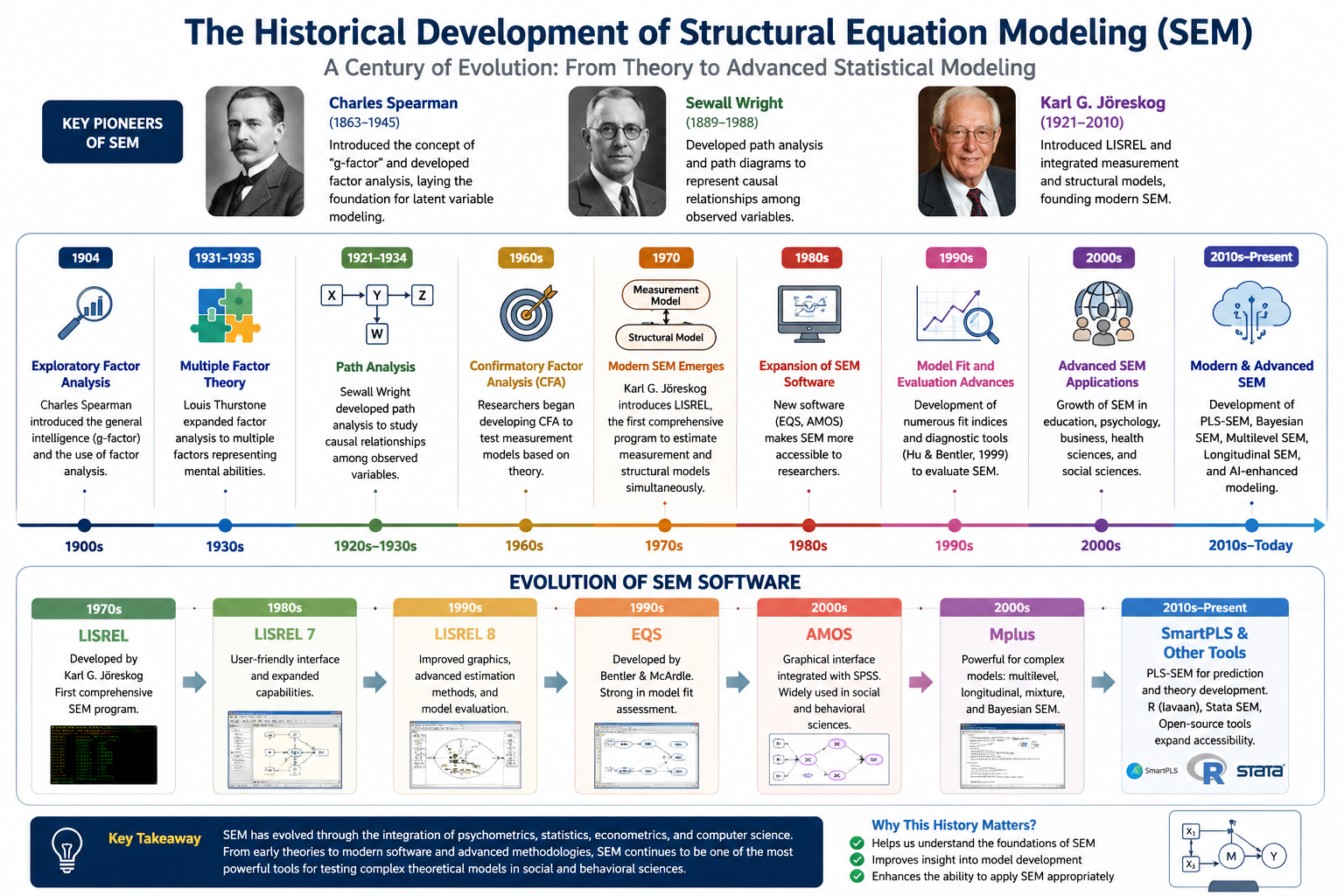
2. Early Foundations (1904–1934)
The roots of SEM can be traced to the early twentieth century with the development of factor analysis, a statistical technique designed to identify underlying latent constructs from observed variables.
In 1904, Charles Spearman introduced exploratory factor analysis while investigating human intelligence. Spearman proposed the concept of a general intelligence factor (g-factor), suggesting that observed test scores were manifestations of an underlying latent construct. This work established the theoretical foundation for latent variable modeling, which later became one of the central components of SEM.
Subsequently, Louis Thurstone expanded factor analytic methods by introducing multiple-factor theory, allowing researchers to represent psychological constructs using several latent dimensions rather than a single general factor.
These pioneering studies laid the psychometric foundation upon which modern measurement models were later developed.
3. Development of Path Analysis (1921–1960)
Another major milestone in the evolution of SEM was the development of path analysis by Sewall Wright.
During the 1920s, Wright introduced path analysis as a method for studying causal relationships among observed variables. He developed path diagrams that visually represented hypothesized causal relationships using arrows connecting variables.
Path analysis enabled researchers to estimate:
- Direct effects
- Indirect effects
- Total effects
Although path analysis did not include latent variables, its graphical representation and simultaneous estimation of multiple relationships became essential components of modern SEM.
4. Integration of Measurement Theory and Structural Analysis (1960s–1970s)
During the 1960s and early 1970s, researchers sought methods capable of combining latent variable measurement with causal modeling.
Important contributions came from econometrics, psychometrics, and sociology. Researchers began integrating confirmatory factor analysis with path analysis, allowing measurement models and structural models to be estimated simultaneously.
This integration represented the conceptual birth of Structural Equation Modeling.
5. The Jöreskog Revolution (1970s)
One of the most significant milestones occurred when Karl G. Jöreskog introduced the LISREL (Linear Structural Relations) model.
LISREL was the first comprehensive statistical framework capable of estimating:
- Measurement models
- Structural models
- Latent variables
- Measurement errors
simultaneously.
The publication of LISREL transformed SEM from a theoretical concept into a practical research methodology. Researchers could now estimate highly complex models using computer software.
Because of this contribution, Karl Jöreskog is widely regarded as one of the founders of modern Structural Equation Modeling.
6. Expansion of SEM Software (1980s–2000s)
The rapid advancement of computer technology greatly accelerated the adoption of SEM.
Several specialized software packages were introduced, including:
- LISREL
- EQS
- AMOS
- Mplus
These programs made SEM increasingly accessible to researchers who did not possess advanced programming skills.
During this period, SEM applications expanded rapidly across education, psychology, business, marketing, sociology, organizational studies, and health sciences.
Researchers also developed numerous model-fit indices that allowed them to evaluate how well theoretical models matched empirical data.
7. Contemporary SEM (2010–Present)
Modern SEM has evolved far beyond traditional covariance-based modeling.
Recent developments include:
- Partial Least Squares SEM (PLS-SEM)
- Bayesian SEM
- Multilevel SEM
- Longitudinal SEM
- Latent Growth Curve Modeling
- Multigroup SEM
- Mixture SEM
Advances in computing power have enabled researchers to estimate increasingly sophisticated models involving large datasets and complex theoretical structures.
Today, SEM is considered one of the standard analytical methods for theory testing in educational and social science research.
| Period | Major Development | Key Scholar(s) |
|---|---|---|
| 1904 | Exploratory Factor Analysis | Charles Spearman |
| 1931–1935 | Multiple Factor Theory | Louis Thurstone |
| 1921–1934 | Path Analysis | Sewall Wright |
| 1960s | Confirmatory Factor Analysis | Various researchers |
| 1970 | LISREL and Modern SEM | Karl G. Jöreskog |
| 1980s | Expansion of SEM Software | Bentler, Byrne, Bollen |
| 1990s | Model Fit Evaluation | Hu & Bentler |
| 2000s | Advanced SEM Applications | Numerous scholars |
| 2010–Present | Bayesian, Multilevel, PLS-SEM | International research community |
9. Historical Contributions to Modern SEM
The development of SEM can be viewed as the integration of four major disciplines:
| Discipline | Contribution to SEM |
|---|---|
| Psychometrics | Measurement of latent variables |
| Statistics | Estimation methods and hypothesis testing |
| Econometrics | Simultaneous equation modeling |
| Computer Science | Specialized SEM software and computational algorithms |
10. Key Takeaways
After completing this subchapter, learners should understand that:
- SEM evolved gradually through the integration of psychometrics, statistics, econometrics, and computer science.
- Factor analysis introduced the concept of latent variables.
- Path analysis provided the foundation for causal modeling.
- Karl Jöreskog's development of LISREL marked the beginning of modern SEM.
- Advances in software and computational methods have made SEM one of the most powerful analytical techniques available today.
11. Reflection Questions
- Why is Charles Spearman considered an important figure in the history of SEM?
- How did Sewall Wright's path analysis contribute to the development of SEM?
- Why was the introduction of LISREL considered a major breakthrough?
- How has computer technology influenced the evolution of SEM?
📝 Suggested Readings (APA 7th)
- Bollen, K. A. (1989). Structural Equations with Latent Variables. John Wiley & Sons.
- Byrne, B. M. (2022). Structural Equation Modeling with AMOS: Basic Concepts, Applications, and Programming (4th ed.). Routledge.
- Hair, J. F., Black, W. C., Babin, B. J., & Anderson, R. E. (2022). Multivariate Data Analysis (9th ed.). Cengage.
- Jöreskog, K. G. (1973). A General Method for Estimating a Linear Structural Equation System. In A. S. Goldberger & O. D. Duncan (Eds.), Structural Equation Models in the Social Sciences. Academic Press.
- Kline, R. B. (2023). Principles and Practice of Structural Equation Modeling (5th ed.). Guilford Press.