Foundations of Structural Equation Modeling
1. Introduction to Structural Equation Modeling
1.4. Advantages of SEM
🎯 Learning Objectives
Upon completion of this subchapter, learners will be able to:
- Explain the major advantages of Structural Equation Modeling (SEM).
- Compare SEM with traditional statistical techniques in terms of analytical capability.
- Describe how SEM improves the accuracy and validity of research findings.
- Explain the role of SEM in testing complex theoretical models.
- Identify research situations in which SEM provides significant methodological advantages.
1. Introduction
Structural Equation Modeling (SEM) has become one of the most influential statistical methodologies in contemporary research because it provides analytical capabilities that extend far beyond those of traditional statistical techniques. Unlike methods that examine isolated relationships among variables, SEM enables researchers to investigate entire theoretical models while accounting for measurement error, latent constructs, and multiple causal pathways.
The growing popularity of SEM across education, psychology, business, management, healthcare, and the social sciences reflects its ability to produce more comprehensive, reliable, and theory-driven research findings. By integrating measurement and structural analyses within a single framework, SEM provides a more realistic representation of complex phenomena.
2. Major Advantages of SEM
Structural Equation Modeling offers numerous advantages that make it the preferred analytical approach for testing theoretical models.
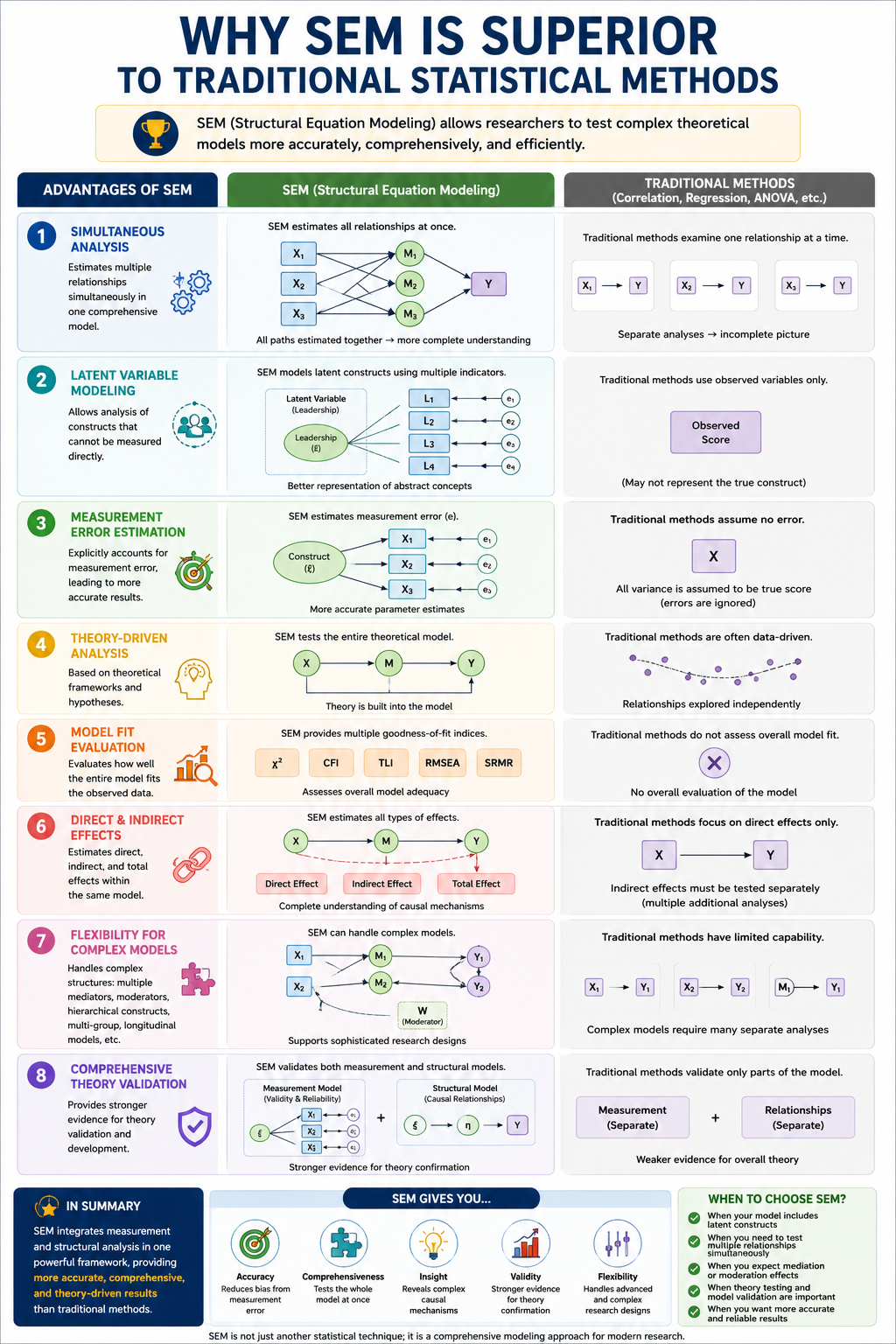
The major advantages include:
- Simultaneous analysis of multiple relationships
- Incorporation of latent variables
- Explicit modeling of measurement error
- Theory-driven hypothesis testing
- Evaluation of overall model fit
- Examination of direct and indirect effects
- Analysis of mediation and moderation
- Greater flexibility for complex research models
Each of these advantages is discussed below.
Figure 1.4 Why SEM is Superior to Traditional Statistical Methods
3. Simultaneous Analysis of Multiple Relationships
Traditional regression analysis evaluates one dependent relationship at a time. In contrast, SEM estimates multiple dependent relationships simultaneously within a single model.
For example, a study investigating educational leadership may examine how leadership influences teacher motivation, organizational commitment, instructional innovation, and student achievement simultaneously.
This capability improves analytical efficiency and provides a more comprehensive understanding of causal mechanisms.
4. Analysis of Latent Variables
Many constructs investigated in educational and social science research cannot be measured directly.
Examples include:
- Leadership
- Creativity
- Learning motivation
- Digital literacy
- Teacher efficacy
- Organizational commitment
SEM allows these latent constructs to be represented by multiple observed indicators, thereby improving construct validity and reducing measurement bias.
5. Explicit Treatment of Measurement Error
Measurement error is unavoidable in survey research and psychological measurement.
Traditional statistical methods generally assume that observed variables are measured without error, which may produce biased estimates.
SEM explicitly incorporates measurement error into the analytical model, resulting in:
- More accurate parameter estimates
- Improved construct validity
- Increased reliability of conclusions
- Stronger empirical evidence
This feature represents one of the most important methodological advantages of SEM.
6. Theory-Driven Analysis
SEM is fundamentally based on theoretical reasoning rather than purely exploratory statistical analysis.
Researchers begin by developing a conceptual framework based on previous literature and theoretical assumptions before collecting data.
SEM then evaluates whether the empirical evidence supports the proposed theoretical model.
Consequently, SEM is regarded primarily as a confirmatory rather than an exploratory statistical technique.
7. Simultaneous Evaluation of Measurement and Structural Models
One of the distinguishing characteristics of SEM is its ability to estimate both:
-
Measurement Model
- Validity of latent constructs
- Reliability of indicators
- Factor loadings
-
Structural Model
- Relationships among latent constructs
- Direct effects
- Indirect effects
- Total effects
This integrated approach enhances both measurement quality and theoretical testing.
8. Evaluation of Overall Model Fit
Unlike traditional statistical methods, SEM evaluates not only individual parameter estimates but also the overall correspondence between the hypothesized model and empirical data.
Researchers assess model adequacy using multiple goodness-of-fit indices, including:
- Chi-square (χ²)
- CFI (Comparative Fit Index)
- TLI (Tucker–Lewis Index)
- RMSEA (Root Mean Square Error of Approximation)
- SRMR (Standardized Root Mean Square Residual)
These indices provide evidence regarding how well the proposed theoretical model represents the observed data.
9. Examination of Direct and Indirect Effects
SEM enables researchers to estimate:
- Direct effects
- Indirect effects
- Total effects
within the same analytical framework.
This capability is especially valuable when investigating mediation models in which one variable influences another through one or more intervening variables.
Such analyses provide deeper insights into the mechanisms underlying causal relationships.
10. Flexibility for Complex Research Models
Modern research frequently involves:
- Multiple dependent variables
- Multiple independent variables
- Hierarchical constructs
- Second-order factors
- Longitudinal relationships
- Multi-group comparisons
SEM provides the flexibility necessary to analyze these sophisticated research designs while maintaining statistical rigor.
11. Summary of Advantages
| Advantage | Benefit to Research |
|---|---|
| Simultaneous analysis | Estimates multiple relationships in one model |
| Latent variable modeling | Measures abstract constructs accurately |
| Measurement error estimation | Produces more reliable parameter estimates |
| Theory testing | Validates conceptual frameworks |
| Model fit evaluation | Assesses the adequacy of the entire model |
| Mediation and moderation analysis | Explores complex causal mechanisms |
| Flexible model specification | Supports advanced research designs |
| Integration of measurement and structural models | Improves validity and reliability simultaneously |
12. Key Takeaways
After completing this subchapter, learners should understand that:
- SEM provides analytical capabilities beyond those of traditional statistical techniques.
- SEM simultaneously estimates multiple relationships among observed and latent variables.
- SEM explicitly accounts for measurement error, leading to more reliable findings.
- SEM is particularly valuable for theory testing and validation.
- SEM supports complex research designs involving mediation, moderation, and hierarchical constructs.
13. Reflection Questions
- Why is simultaneous estimation considered one of the greatest strengths of SEM?
- How does SEM improve construct validity through latent variable modeling?
- Why is explicit treatment of measurement error important in research?
- How does SEM contribute to theory testing and model validation?
- Which advantage of SEM do you consider most valuable for your own research, and why?
Suggested Readings (APA 7th)
- Bollen, K. A. (1989). Structural Equations with Latent Variables. John Wiley & Sons.
- Byrne, B. M. (2022). Structural Equation Modeling with AMOS: Basic Concepts, Applications, and Programming (4th ed.). Routledge.
- Hair, J. F., Black, W. C., Babin, B. J., & Anderson, R. E. (2022). Multivariate Data Analysis (9th ed.). Cengage.
- Kline, R. B. (2023). Principles and Practice of Structural Equation Modeling (5th ed.). Guilford Press.
- Schumacker, R. E., & Lomax, R. G. (2022). A Beginner's Guide to Structural Equation Modeling (5th ed.). Routledge.