Foundations of Structural Equation Modeling
| Site: | Dr.Darunee academy |
| Course: | 📘 Book 1: Foundations of Structural Equation Modeling |
| Book: | Foundations of Structural Equation Modeling |
| Printed by: | Guest user |
| Date: | Sunday, 18 October 2026, 10:36 AM |
Table of contents
- 1. Introduction to Structural Equation Modeling
- 2. Fundamental Concepts in Structural Equation Modeling
- 3. Components of Structural Equation Modeling
- 4. Types of Structural Equation Models
- 5. Assumptions of Structural Equation Modeling
- 6. The Structural Equation Modeling Process
- 7. SEM Software
- 8. Summary and Preparation for Advanced SEM
1. Introduction to Structural Equation Modeling
Structural Equation Modeling (SEM) is a comprehensive multivariate statistical technique used to examine complex relationships among observed and latent variables. SEM integrates factor analysis and multiple regression into a unified analytical framework, enabling researchers to test theoretical models while accounting for measurement error. Due to its flexibility and analytical power, SEM has become one of the most widely used methods in education, psychology, social sciences, business, and health research. This chapter introduces the fundamental concepts, historical development, advantages, limitations, and overall research process of Structural Equation Modeling, providing a solid foundation for the subsequent chapters.1.1. What is Structural Equation Modeling?
🎯 Learning Objectives
Upon completion of this subchapter, learners will be able to:
- Define Structural Equation Modeling (SEM).
- Explain the fundamental characteristics of SEM.
- Distinguish SEM from traditional statistical techniques.
- Describe the major components of SEM.
- Explain why SEM has become one of the most widely used analytical methods in educational and social science research.
1. Introduction
Structural Equation Modeling (SEM) is one of the most powerful multivariate statistical techniques available for testing theoretical models involving complex relationships among variables. Unlike conventional statistical methods that examine relationships separately, SEM enables researchers to evaluate an entire theoretical framework simultaneously while accounting for measurement error.
SEM integrates the strengths of multiple regression analysis, path analysis, and confirmatory factor analysis (CFA) into a single analytical framework. This capability allows researchers to examine both direct and indirect relationships among observed and latent variables, making SEM particularly suitable for educational, psychological, behavioral, management, and social science research.
In educational research, many important concepts—such as learning motivation, instructional quality, leadership, organizational commitment, creativity, digital literacy, and academic achievement—cannot be measured directly. These constructs are considered latent variables and require multiple observed indicators for accurate measurement. SEM provides an appropriate methodology for analyzing these complex constructs while simultaneously evaluating the quality of measurement instruments and testing theoretical relationships.
2. Definition of Structural Equation Modeling
Structural Equation Modeling (SEM) is a comprehensive multivariate statistical methodology used to examine causal relationships among observed variables and latent variables based on theoretical models. SEM combines measurement theory with structural relationships, allowing researchers to test how well empirical data support a hypothesized conceptual framework.
Unlike traditional regression analysis, SEM enables researchers to estimate multiple dependent relationships simultaneously and explicitly incorporates measurement errors into the analysis. Consequently, SEM produces more accurate parameter estimates and stronger evidence for theory testing.
Several scholars have defined SEM as follows:
- Kline (2023) describes SEM as a statistical methodology for testing and estimating complex causal relationships among variables using a combination of statistical data and theoretical assumptions.
- Hair et al. (2022) define SEM as a second-generation multivariate analysis technique that simultaneously estimates relationships among multiple dependent and independent variables.
- Byrne (2022) emphasizes that SEM integrates confirmatory factor analysis and path analysis into one comprehensive analytical procedure.
3. Key Characteristics of SEM
Structural Equation Modeling possesses several unique characteristics that distinguish it from traditional statistical methods.
3.1 Simultaneous Analysis
SEM estimates multiple relationships among variables in a single statistical model rather than conducting several separate analyses.
3.2 Latent Variable Analysis
SEM allows researchers to analyze constructs that cannot be measured directly, such as attitudes, motivation, leadership, or creativity.
3.3 Measurement Error Control
Unlike traditional regression techniques, SEM explicitly incorporates measurement error into the model, leading to more reliable parameter estimates.
3.4 Theory-Driven Analysis
SEM is fundamentally theory-based. Researchers develop a conceptual model grounded in literature before testing whether empirical data support the proposed theoretical relationships.
3.5 Comprehensive Model Evaluation
SEM evaluates both individual parameter estimates and the overall goodness-of-fit between the proposed model and observed data.
4. Why is SEM Important?
SEM has become increasingly popular because many research problems involve multiple interrelated variables that cannot be adequately analyzed using traditional statistical techniques.
Major advantages include:
- Simultaneous testing of multiple hypotheses
- Analysis of direct and indirect effects
- Examination of mediation and moderation effects
- Assessment of latent constructs
- Evaluation of measurement validity and reliability
- Testing of complex theoretical models
These capabilities make SEM one of the preferred analytical methods for contemporary educational research.
5. Applications of SEM
SEM has been widely applied in numerous research disciplines.
Educational Research
- Learning motivation
- Teacher effectiveness
- Educational leadership
- Student engagement
- Digital literacy
- Creativity
- Learning outcomes
Psychology
- Personality
- Mental health
- Cognitive ability
- Emotional intelligence
Business and Management
- Organizational commitment
- Customer satisfaction
- Employee performance
- Leadership effectiveness
Health Sciences
- Quality of life
- Health behavior
- Patient satisfaction
6. Advantages over Traditional Statistical Techniques
| Traditional Statistics | Structural Equation Modeling |
|---|---|
| One dependent variable at a time | Multiple dependent variables simultaneously |
| Observed variables only | Observed and latent variables |
| Measurement error ignored | Measurement error explicitly modeled |
| Separate analyses required | Entire theoretical model analyzed simultaneously |
| Limited mediation analysis | Direct, indirect, and total effects estimated simultaneously |
7. Key Takeaways
After completing this subchapter, learners should understand that:
- SEM is a second-generation multivariate statistical technique.
- SEM combines factor analysis and regression analysis into one analytical framework.
- SEM analyzes relationships among both observed and latent variables.
- SEM explicitly accounts for measurement error.
- SEM is primarily theory-driven and widely used for testing complex conceptual models in educational and social science research.
8. Reflection Questions
- Why is SEM considered more powerful than multiple regression analysis?
- What is the difference between observed variables and latent variables?
- Why is measurement error explicitly modeled in SEM?
- In what types of educational research would SEM be the most appropriate analytical method?
📝 Suggested Readings (APA 7th)
- Byrne, B. M. (2022). Structural Equation Modeling with AMOS: Basic Concepts, Applications, and Programming (4th ed.). Routledge.
- Hair, J. F., Black, W. C., Babin, B. J., & Anderson, R. E. (2022). Multivariate Data Analysis (9th ed.). Cengage.
- Kline, R. B. (2023). Principles and Practice of Structural Equation Modeling (5th ed.). Guilford Press.
- Schumacker, R. E., & Lomax, R. G. (2022). A Beginner's Guide to Structural Equation Modeling (5th ed.). Routledge.
1.2. Historical Development of SEM
🎯 Learning Objectives
Upon completion of this subchapter, learners will be able to:
- Describe the historical development of Structural Equation Modeling (SEM).
- Identify the major milestones in the evolution of SEM.
- Explain the contributions of key scholars to SEM methodology.
- Understand how factor analysis, path analysis, and econometrics contributed to modern SEM.
- Recognize the impact of computer technology and specialized software on the advancement of SEM.
1. Introduction
Structural Equation Modeling (SEM) did not emerge as a single statistical technique but evolved through the integration of several methodological traditions over nearly a century. Its development reflects the combined contributions of psychometrics, statistics, econometrics, and computer science. Today, SEM is recognized as one of the most comprehensive analytical approaches for testing complex theoretical models involving both observed and latent variables.
Understanding the historical development of SEM provides researchers with valuable insights into its theoretical foundations and methodological evolution. It also helps explain why SEM has become one of the most influential statistical techniques in educational research, psychology, management, sociology, and health sciences.
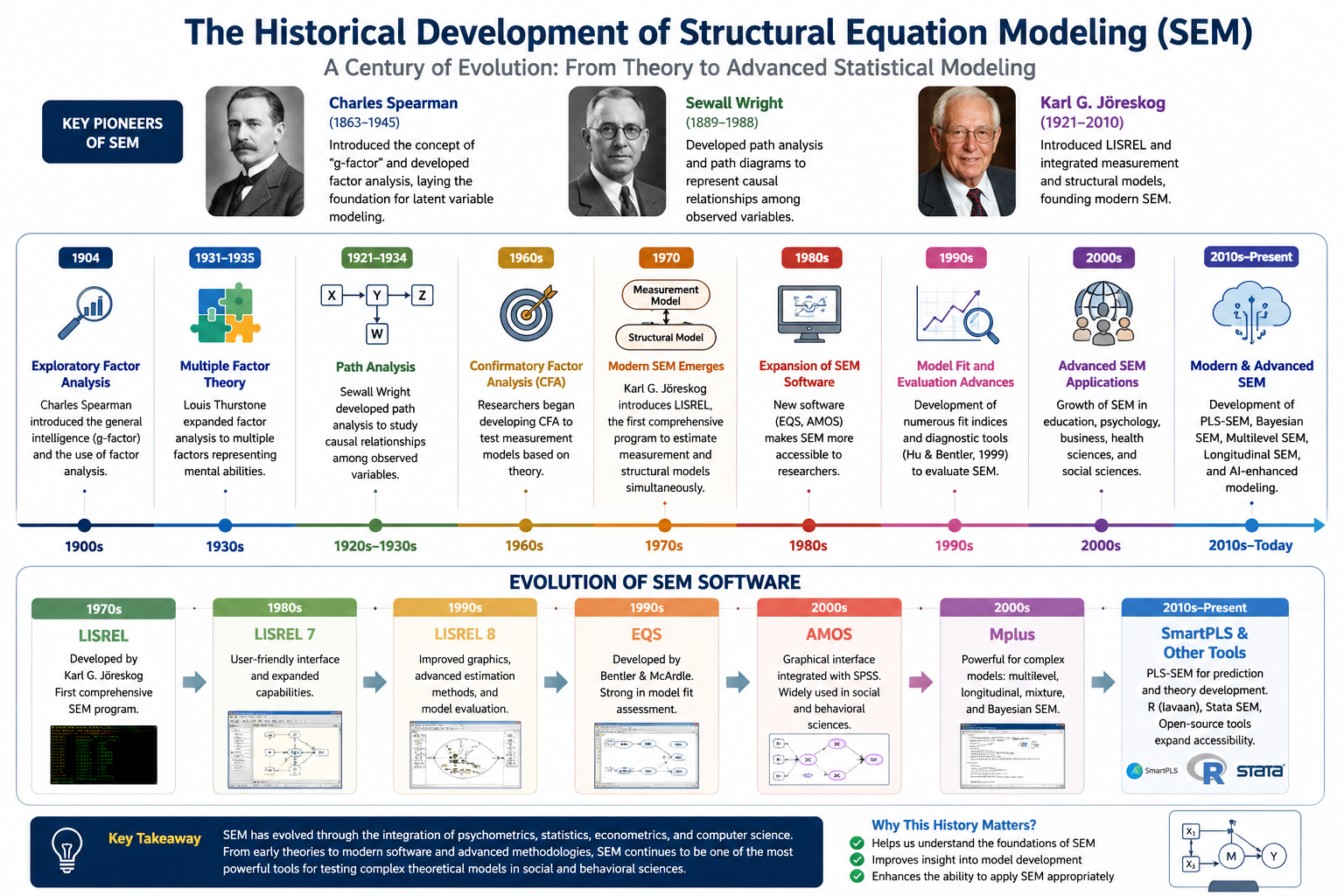
2. Early Foundations (1904–1934)
The roots of SEM can be traced to the early twentieth century with the development of factor analysis, a statistical technique designed to identify underlying latent constructs from observed variables.
In 1904, Charles Spearman introduced exploratory factor analysis while investigating human intelligence. Spearman proposed the concept of a general intelligence factor (g-factor), suggesting that observed test scores were manifestations of an underlying latent construct. This work established the theoretical foundation for latent variable modeling, which later became one of the central components of SEM.
Subsequently, Louis Thurstone expanded factor analytic methods by introducing multiple-factor theory, allowing researchers to represent psychological constructs using several latent dimensions rather than a single general factor.
These pioneering studies laid the psychometric foundation upon which modern measurement models were later developed.
3. Development of Path Analysis (1921–1960)
Another major milestone in the evolution of SEM was the development of path analysis by Sewall Wright.
During the 1920s, Wright introduced path analysis as a method for studying causal relationships among observed variables. He developed path diagrams that visually represented hypothesized causal relationships using arrows connecting variables.
Path analysis enabled researchers to estimate:
- Direct effects
- Indirect effects
- Total effects
Although path analysis did not include latent variables, its graphical representation and simultaneous estimation of multiple relationships became essential components of modern SEM.
4. Integration of Measurement Theory and Structural Analysis (1960s–1970s)
During the 1960s and early 1970s, researchers sought methods capable of combining latent variable measurement with causal modeling.
Important contributions came from econometrics, psychometrics, and sociology. Researchers began integrating confirmatory factor analysis with path analysis, allowing measurement models and structural models to be estimated simultaneously.
This integration represented the conceptual birth of Structural Equation Modeling.
5. The Jöreskog Revolution (1970s)
One of the most significant milestones occurred when Karl G. Jöreskog introduced the LISREL (Linear Structural Relations) model.
LISREL was the first comprehensive statistical framework capable of estimating:
- Measurement models
- Structural models
- Latent variables
- Measurement errors
simultaneously.
The publication of LISREL transformed SEM from a theoretical concept into a practical research methodology. Researchers could now estimate highly complex models using computer software.
Because of this contribution, Karl Jöreskog is widely regarded as one of the founders of modern Structural Equation Modeling.
6. Expansion of SEM Software (1980s–2000s)
The rapid advancement of computer technology greatly accelerated the adoption of SEM.
Several specialized software packages were introduced, including:
- LISREL
- EQS
- AMOS
- Mplus
These programs made SEM increasingly accessible to researchers who did not possess advanced programming skills.
During this period, SEM applications expanded rapidly across education, psychology, business, marketing, sociology, organizational studies, and health sciences.
Researchers also developed numerous model-fit indices that allowed them to evaluate how well theoretical models matched empirical data.
7. Contemporary SEM (2010–Present)
Modern SEM has evolved far beyond traditional covariance-based modeling.
Recent developments include:
- Partial Least Squares SEM (PLS-SEM)
- Bayesian SEM
- Multilevel SEM
- Longitudinal SEM
- Latent Growth Curve Modeling
- Multigroup SEM
- Mixture SEM
Advances in computing power have enabled researchers to estimate increasingly sophisticated models involving large datasets and complex theoretical structures.
Today, SEM is considered one of the standard analytical methods for theory testing in educational and social science research.
| Period | Major Development | Key Scholar(s) |
|---|---|---|
| 1904 | Exploratory Factor Analysis | Charles Spearman |
| 1931–1935 | Multiple Factor Theory | Louis Thurstone |
| 1921–1934 | Path Analysis | Sewall Wright |
| 1960s | Confirmatory Factor Analysis | Various researchers |
| 1970 | LISREL and Modern SEM | Karl G. Jöreskog |
| 1980s | Expansion of SEM Software | Bentler, Byrne, Bollen |
| 1990s | Model Fit Evaluation | Hu & Bentler |
| 2000s | Advanced SEM Applications | Numerous scholars |
| 2010–Present | Bayesian, Multilevel, PLS-SEM | International research community |
9. Historical Contributions to Modern SEM
The development of SEM can be viewed as the integration of four major disciplines:
| Discipline | Contribution to SEM |
|---|---|
| Psychometrics | Measurement of latent variables |
| Statistics | Estimation methods and hypothesis testing |
| Econometrics | Simultaneous equation modeling |
| Computer Science | Specialized SEM software and computational algorithms |
10. Key Takeaways
After completing this subchapter, learners should understand that:
- SEM evolved gradually through the integration of psychometrics, statistics, econometrics, and computer science.
- Factor analysis introduced the concept of latent variables.
- Path analysis provided the foundation for causal modeling.
- Karl Jöreskog's development of LISREL marked the beginning of modern SEM.
- Advances in software and computational methods have made SEM one of the most powerful analytical techniques available today.
11. Reflection Questions
- Why is Charles Spearman considered an important figure in the history of SEM?
- How did Sewall Wright's path analysis contribute to the development of SEM?
- Why was the introduction of LISREL considered a major breakthrough?
- How has computer technology influenced the evolution of SEM?
📝 Suggested Readings (APA 7th)
- Bollen, K. A. (1989). Structural Equations with Latent Variables. John Wiley & Sons.
- Byrne, B. M. (2022). Structural Equation Modeling with AMOS: Basic Concepts, Applications, and Programming (4th ed.). Routledge.
- Hair, J. F., Black, W. C., Babin, B. J., & Anderson, R. E. (2022). Multivariate Data Analysis (9th ed.). Cengage.
- Jöreskog, K. G. (1973). A General Method for Estimating a Linear Structural Equation System. In A. S. Goldberger & O. D. Duncan (Eds.), Structural Equation Models in the Social Sciences. Academic Press.
- Kline, R. B. (2023). Principles and Practice of Structural Equation Modeling (5th ed.). Guilford Press.
1.3. Importance of SEM in Research
🎯 Learning Objectives
Upon completion of this subchapter, learners will be able to:
- Explain the significance of Structural Equation Modeling (SEM) in contemporary research.
- Describe the advantages of SEM for testing theoretical models.
- Explain why SEM is widely used in educational, behavioral, and social science research.
- Identify research situations where SEM is more appropriate than traditional statistical techniques.
- Recognize the contribution of SEM to theory development and validation.
1. Introduction
As research questions become increasingly complex, traditional statistical techniques such as correlation, multiple regression, and analysis of variance (ANOVA) are often insufficient to capture the multidimensional relationships among variables. Researchers frequently seek to examine not only direct effects but also indirect effects, mediating mechanisms, latent constructs, and multiple causal pathways within a single theoretical framework.
Structural Equation Modeling (SEM) addresses these analytical challenges by integrating measurement models and structural models into a unified statistical framework. This capability enables researchers to evaluate the validity of measurement instruments while simultaneously testing theoretical relationships among variables. Consequently, SEM has become one of the most influential analytical methodologies in education, psychology, management, sociology, healthcare, and many other scientific disciplines.
2. Why SEM is Important in Modern Research
SEM is considered a second-generation multivariate analysis technique because it extends beyond the capabilities of traditional statistical methods. Rather than testing isolated relationships between variables, SEM enables researchers to evaluate an entire conceptual model simultaneously.
Figure 1.3 Why Researchers Choose SEM: A Comparison of SEM with Correlation, Regression, ANOVA, and Path Analysis
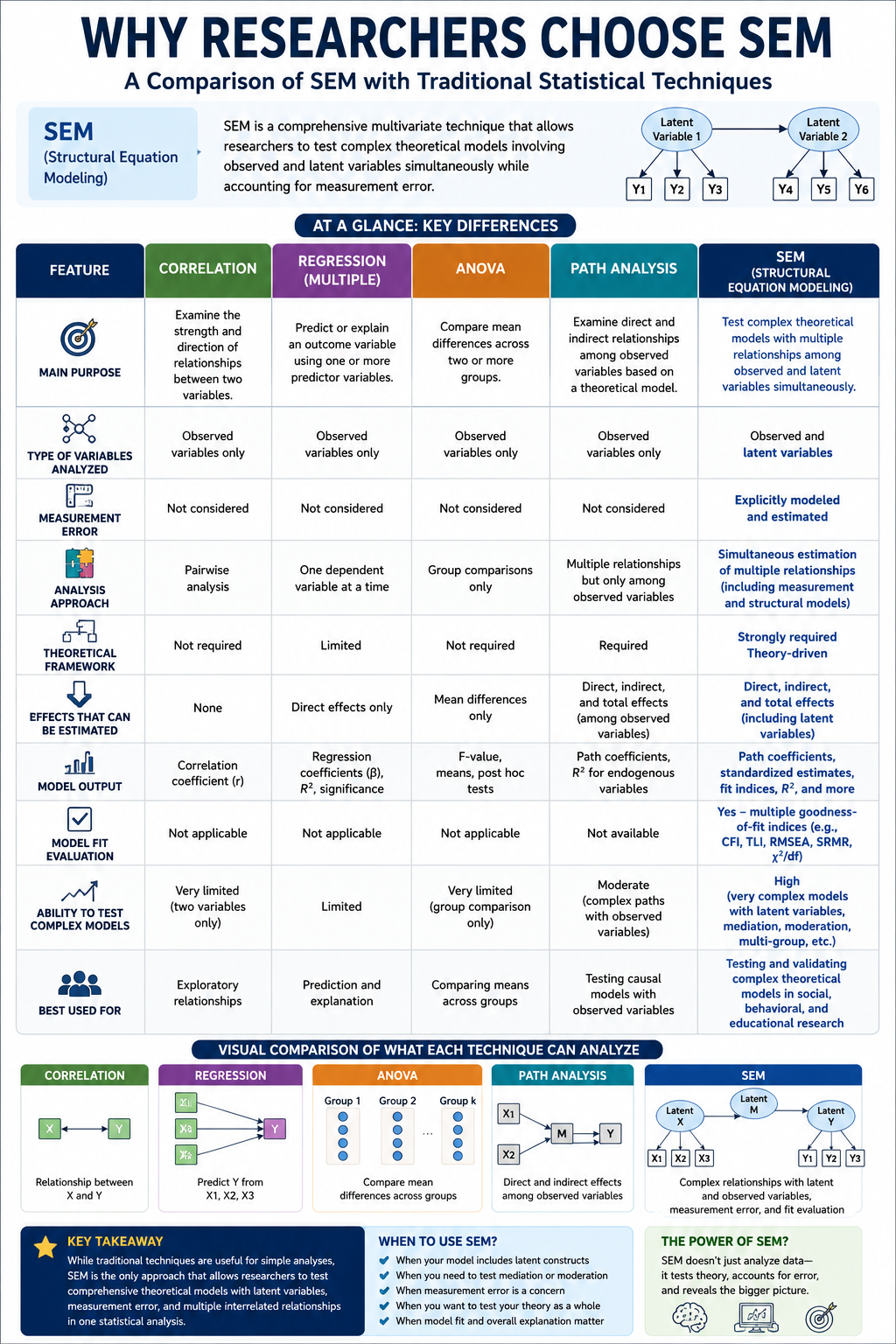
Figure 1.3 illustrates the major differences between Structural Equation Modeling (SEM) and traditional statistical techniques, including correlation analysis, multiple regression, analysis of variance (ANOVA), and path analysis. Unlike conventional methods that examine only specific aspects of relationships among observed variables, SEM simultaneously evaluates latent constructs, measurement errors, multiple causal pathways, and the overall fit between the theoretical model and empirical data. These capabilities explain why SEM has become the preferred analytical methodology for theory testing in educational and social science research.
The importance of SEM lies in its ability to provide a comprehensive understanding of complex phenomena while minimizing bias caused by measurement error.
Major reasons include:
- Testing comprehensive theoretical models
- Simultaneous estimation of multiple relationships
- Explicit modeling of latent variables
- Control of measurement error
- Assessment of model fit
- Support for theory development and validation
3. Importance of SEM in Theory Testing
One of the primary purposes of scientific research is to test theoretical propositions. SEM is particularly valuable because it allows researchers to examine whether empirical data support a proposed conceptual framework.
Unlike traditional regression analysis, which evaluates individual equations separately, SEM estimates all structural relationships simultaneously while considering the interdependence among variables.
This capability strengthens theory testing by allowing researchers to evaluate:
- Direct effects
- Indirect effects
- Total effects
- Mediating relationships
- Moderating relationships
- Complex causal structures
As a result, SEM has become the preferred methodology for confirmatory research.
4. Importance of SEM in Educational Research
Educational research frequently investigates constructs that cannot be measured directly. Examples include:
- Learning motivation
- Student engagement
- Creativity
- Digital literacy
- Teacher effectiveness
- Leadership
- Organizational commitment
- Academic resilience
These constructs are latent variables that require multiple observed indicators for accurate measurement.
SEM enables researchers to:
- Validate measurement instruments using Confirmatory Factor Analysis (CFA)
- Test theoretical relationships among educational constructs
- Examine causal pathways affecting learning outcomes
- Evaluate educational intervention models
- Improve the accuracy of educational decision-making
Consequently, SEM has become one of the most widely used statistical methods in educational administration, curriculum studies, educational technology, and educational psychology.
5. Importance of SEM in Social and Behavioral Sciences
SEM has significantly advanced research in psychology, sociology, business, healthcare, and organizational studies by enabling the investigation of complex human behaviors.
Researchers use SEM to study:
- Customer satisfaction
- Consumer behavior
- Employee engagement
- Organizational commitment
- Leadership effectiveness
- Emotional intelligence
- Mental health
- Quality of life
The flexibility of SEM allows researchers to construct comprehensive models that better reflect real-world phenomena.
6. Comparison with Traditional Statistical Methods
| Traditional Statistical Methods | Structural Equation Modeling |
|---|---|
| Examine individual relationships | Examine an entire theoretical model |
| Limited to observed variables | Include observed and latent variables |
| Ignore measurement error | Explicitly estimate measurement error |
| Separate analyses required | Simultaneous estimation of multiple relationships |
| Limited mediation analysis | Comprehensive mediation and moderation analysis |
| No assessment of overall model fit | Evaluate model fit using multiple fit indices |
7. Contribution of SEM to Scientific Research
SEM has transformed modern scientific research by providing researchers with tools to:
- Develop stronger theoretical models.
- Validate research instruments.
- Test causal relationships more accurately.
- Evaluate complex systems involving multiple variables.
- Improve the reliability and validity of research findings.
- Generate stronger empirical evidence for theory building.
For these reasons, SEM is regarded as one of the most powerful analytical approaches available for hypothesis testing and theory confirmation.
8. Practical Applications of SEM
SEM has been applied extensively in numerous disciplines.
Education
- Educational leadership
- Technology acceptance
- Learning achievement
- Student engagement
- Creativity
- Digital competence
Business
- Organizational performance
- Customer loyalty
- Brand equity
- Employee satisfaction
Health Sciences
- Health behavior
- Patient satisfaction
- Healthcare quality
- Mental health interventions
Social Sciences
- Social capital
- Public policy evaluation
- Community development
- Social behavior
9. Key Takeaways
After completing this subchapter, learners should understand that:
- SEM is one of the most important analytical methods for contemporary research.
- SEM enables researchers to test complex theoretical models.
- SEM simultaneously evaluates measurement quality and structural relationships.
- SEM provides stronger evidence for theory validation than many traditional statistical techniques.
- SEM has become the preferred analytical approach in education, psychology, management, healthcare, and social sciences.
10. Reflection Questions
- Why is SEM considered a second-generation multivariate statistical technique?
- What advantages does SEM provide over multiple regression analysis?
- Why is SEM particularly valuable in educational research?
- How does SEM contribute to theory development and validation?
- In your own research area, how could SEM improve the quality of empirical investigation?
📝 Suggested Readings (APA 7th)
- Byrne, B. M. (2022). Structural Equation Modeling with AMOS: Basic Concepts, Applications, and Programming (4th ed.). Routledge.
- Hair, J. F., Black, W. C., Babin, B. J., & Anderson, R. E. (2022). Multivariate Data Analysis (9th ed.). Cengage.
- Kline, R. B. (2023). Principles and Practice of Structural Equation Modeling (5th ed.). Guilford Press.
- Schumacker, R. E., & Lomax, R. G. (2022). A Beginner's Guide to Structural Equation Modeling (5th ed.). Routledge.
1.4. Advantages of SEM
🎯 Learning Objectives
Upon completion of this subchapter, learners will be able to:
- Explain the major advantages of Structural Equation Modeling (SEM).
- Compare SEM with traditional statistical techniques in terms of analytical capability.
- Describe how SEM improves the accuracy and validity of research findings.
- Explain the role of SEM in testing complex theoretical models.
- Identify research situations in which SEM provides significant methodological advantages.
1. Introduction
Structural Equation Modeling (SEM) has become one of the most influential statistical methodologies in contemporary research because it provides analytical capabilities that extend far beyond those of traditional statistical techniques. Unlike methods that examine isolated relationships among variables, SEM enables researchers to investigate entire theoretical models while accounting for measurement error, latent constructs, and multiple causal pathways.
The growing popularity of SEM across education, psychology, business, management, healthcare, and the social sciences reflects its ability to produce more comprehensive, reliable, and theory-driven research findings. By integrating measurement and structural analyses within a single framework, SEM provides a more realistic representation of complex phenomena.
2. Major Advantages of SEM
Structural Equation Modeling offers numerous advantages that make it the preferred analytical approach for testing theoretical models.
The major advantages include:
- Simultaneous analysis of multiple relationships
- Incorporation of latent variables
- Explicit modeling of measurement error
- Theory-driven hypothesis testing
- Evaluation of overall model fit
- Examination of direct and indirect effects
- Analysis of mediation and moderation
- Greater flexibility for complex research models
Each of these advantages is discussed below.
Figure 1.4 Why SEM is Superior to Traditional Statistical Methods
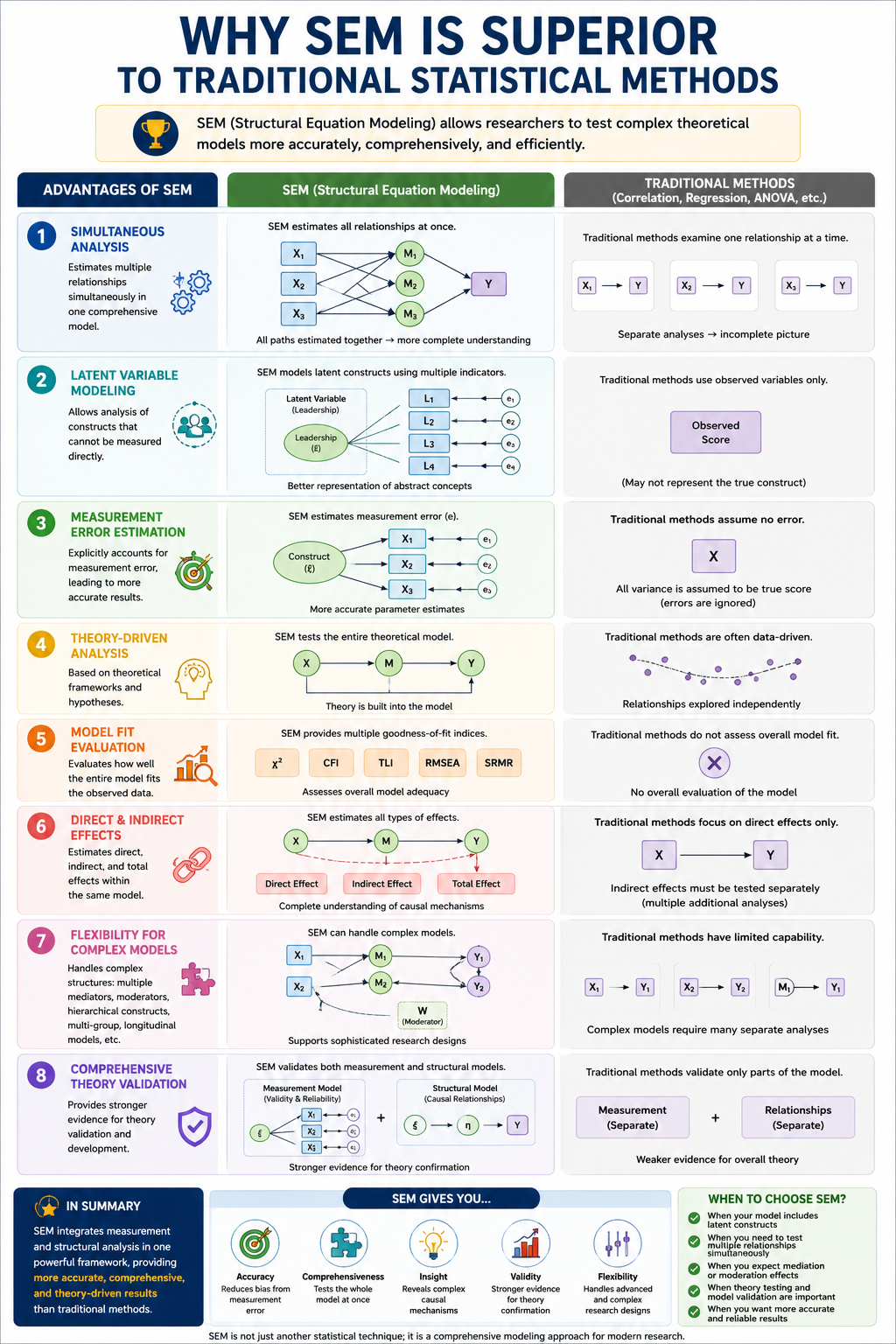
3. Simultaneous Analysis of Multiple Relationships
Traditional regression analysis evaluates one dependent relationship at a time. In contrast, SEM estimates multiple dependent relationships simultaneously within a single model.
For example, a study investigating educational leadership may examine how leadership influences teacher motivation, organizational commitment, instructional innovation, and student achievement simultaneously.
This capability improves analytical efficiency and provides a more comprehensive understanding of causal mechanisms.
4. Analysis of Latent Variables
Many constructs investigated in educational and social science research cannot be measured directly.
Examples include:
- Leadership
- Creativity
- Learning motivation
- Digital literacy
- Teacher efficacy
- Organizational commitment
SEM allows these latent constructs to be represented by multiple observed indicators, thereby improving construct validity and reducing measurement bias.
5. Explicit Treatment of Measurement Error
Measurement error is unavoidable in survey research and psychological measurement.
Traditional statistical methods generally assume that observed variables are measured without error, which may produce biased estimates.
SEM explicitly incorporates measurement error into the analytical model, resulting in:
- More accurate parameter estimates
- Improved construct validity
- Increased reliability of conclusions
- Stronger empirical evidence
This feature represents one of the most important methodological advantages of SEM.
6. Theory-Driven Analysis
SEM is fundamentally based on theoretical reasoning rather than purely exploratory statistical analysis.
Researchers begin by developing a conceptual framework based on previous literature and theoretical assumptions before collecting data.
SEM then evaluates whether the empirical evidence supports the proposed theoretical model.
Consequently, SEM is regarded primarily as a confirmatory rather than an exploratory statistical technique.
7. Simultaneous Evaluation of Measurement and Structural Models
One of the distinguishing characteristics of SEM is its ability to estimate both:
-
Measurement Model
- Validity of latent constructs
- Reliability of indicators
- Factor loadings
-
Structural Model
- Relationships among latent constructs
- Direct effects
- Indirect effects
- Total effects
This integrated approach enhances both measurement quality and theoretical testing.
8. Evaluation of Overall Model Fit
Unlike traditional statistical methods, SEM evaluates not only individual parameter estimates but also the overall correspondence between the hypothesized model and empirical data.
Researchers assess model adequacy using multiple goodness-of-fit indices, including:
- Chi-square (χ²)
- CFI (Comparative Fit Index)
- TLI (Tucker–Lewis Index)
- RMSEA (Root Mean Square Error of Approximation)
- SRMR (Standardized Root Mean Square Residual)
These indices provide evidence regarding how well the proposed theoretical model represents the observed data.
9. Examination of Direct and Indirect Effects
SEM enables researchers to estimate:
- Direct effects
- Indirect effects
- Total effects
within the same analytical framework.
This capability is especially valuable when investigating mediation models in which one variable influences another through one or more intervening variables.
Such analyses provide deeper insights into the mechanisms underlying causal relationships.
10. Flexibility for Complex Research Models
Modern research frequently involves:
- Multiple dependent variables
- Multiple independent variables
- Hierarchical constructs
- Second-order factors
- Longitudinal relationships
- Multi-group comparisons
SEM provides the flexibility necessary to analyze these sophisticated research designs while maintaining statistical rigor.
11. Summary of Advantages
| Advantage | Benefit to Research |
|---|---|
| Simultaneous analysis | Estimates multiple relationships in one model |
| Latent variable modeling | Measures abstract constructs accurately |
| Measurement error estimation | Produces more reliable parameter estimates |
| Theory testing | Validates conceptual frameworks |
| Model fit evaluation | Assesses the adequacy of the entire model |
| Mediation and moderation analysis | Explores complex causal mechanisms |
| Flexible model specification | Supports advanced research designs |
| Integration of measurement and structural models | Improves validity and reliability simultaneously |
12. Key Takeaways
After completing this subchapter, learners should understand that:
- SEM provides analytical capabilities beyond those of traditional statistical techniques.
- SEM simultaneously estimates multiple relationships among observed and latent variables.
- SEM explicitly accounts for measurement error, leading to more reliable findings.
- SEM is particularly valuable for theory testing and validation.
- SEM supports complex research designs involving mediation, moderation, and hierarchical constructs.
13. Reflection Questions
- Why is simultaneous estimation considered one of the greatest strengths of SEM?
- How does SEM improve construct validity through latent variable modeling?
- Why is explicit treatment of measurement error important in research?
- How does SEM contribute to theory testing and model validation?
- Which advantage of SEM do you consider most valuable for your own research, and why?
Suggested Readings (APA 7th)
- Bollen, K. A. (1989). Structural Equations with Latent Variables. John Wiley & Sons.
- Byrne, B. M. (2022). Structural Equation Modeling with AMOS: Basic Concepts, Applications, and Programming (4th ed.). Routledge.
- Hair, J. F., Black, W. C., Babin, B. J., & Anderson, R. E. (2022). Multivariate Data Analysis (9th ed.). Cengage.
- Kline, R. B. (2023). Principles and Practice of Structural Equation Modeling (5th ed.). Guilford Press.
- Schumacker, R. E., & Lomax, R. G. (2022). A Beginner's Guide to Structural Equation Modeling (5th ed.). Routledge.
1.5. Limitations of SEM
🎯 Learning Objectives
Upon completion of this subchapter, learners will be able to:
- Explain the major limitations of Structural Equation Modeling (SEM).
- Identify common challenges encountered when applying SEM in research.
- Recognize the assumptions underlying SEM analysis.
- Evaluate situations in which SEM may not be the most appropriate statistical technique.
- Apply strategies to minimize the limitations of SEM in research practice.
1. Introduction
Although Structural Equation Modeling (SEM) is recognized as one of the most powerful multivariate statistical techniques, it is not without limitations. Like all statistical methodologies, SEM relies on a number of theoretical assumptions, methodological requirements, and practical considerations that researchers must carefully address before conducting an analysis.
Many problems encountered in SEM are not caused by the software itself but by inadequate research design, insufficient sample size, poor measurement quality, or inappropriate model specification. Consequently, researchers should understand both the strengths and limitations of SEM to ensure that the technique is applied appropriately and that research findings are interpreted accurately.
2. Major Limitations of SEM
Despite its analytical power, SEM has several important limitations, including:
- Large sample size requirements
- Sensitivity to model specification
- Assumptions of multivariate normality
- Complexity of model development
- Dependence on theoretical justification
- Sensitivity to poor-quality measurement instruments
- Risk of model overfitting
- Requirement for advanced statistical knowledge
Understanding these limitations helps researchers make informed methodological decisions.
Figure 1.5 Challenges and Limitations of Structural Equation Modeling (SEM)
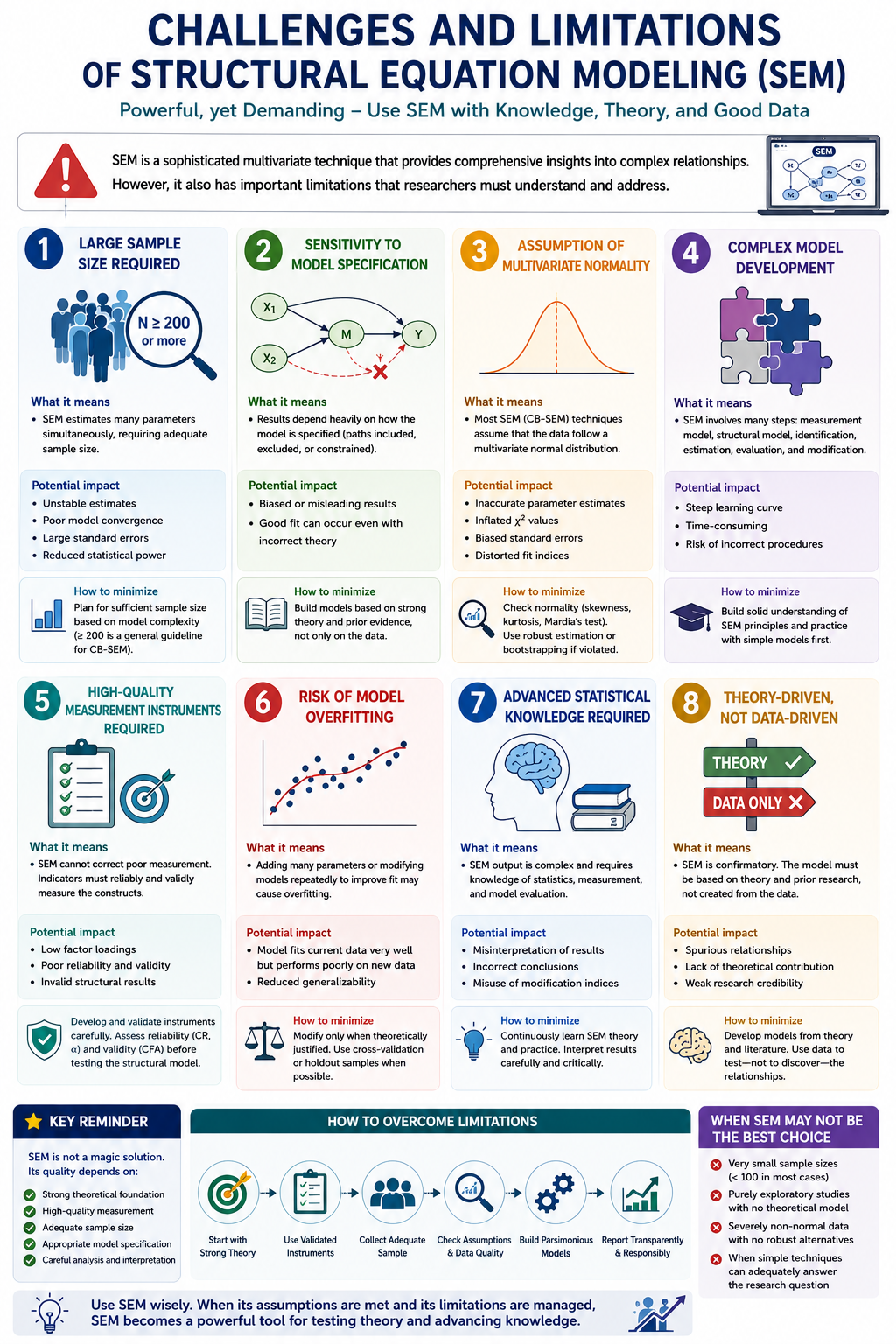
3. Large Sample Size Requirements
One of the most frequently discussed limitations of SEM is the need for relatively large sample sizes.
Because SEM estimates many parameters simultaneously, insufficient sample sizes may lead to:
- Unstable parameter estimates
- Poor model convergence
- Inflated standard errors
- Reduced statistical power
Although recommended sample sizes vary depending on model complexity, many researchers suggest a minimum of 200 observations for covariance-based SEM, while more complex models may require substantially larger samples.
4. Sensitivity to Model Specification
SEM is highly dependent on the correctness of the proposed theoretical model.
If researchers specify incorrect causal relationships, omit important variables, or include inappropriate paths, the resulting estimates may be misleading even when model-fit indices appear acceptable.
Therefore, SEM should always be theory-driven rather than data-driven.
5. Assumptions of Multivariate Normality
Most covariance-based SEM techniques assume that the observed data follow a multivariate normal distribution.
Violations of this assumption may affect:
- Parameter estimation
- Standard errors
- Chi-square statistics
- Model-fit indices
Researchers should therefore conduct preliminary data screening before SEM analysis.
6. Complexity of Model Development
Compared with traditional statistical methods, SEM requires considerably more expertise.
Researchers must understand:
- Measurement theory
- Confirmatory Factor Analysis (CFA)
- Structural models
- Model identification
- Parameter estimation
- Model evaluation
- Model modification
This complexity increases the learning curve for beginning researchers.
7. Dependence on High-Quality Measurement Instruments
SEM cannot compensate for poorly designed questionnaires or unreliable measurement instruments.
If observed indicators fail to measure latent constructs accurately, the resulting structural model will also be unreliable.
For this reason, instrument development and validation are essential prerequisites for successful SEM analysis.
8. Risk of Model Overfitting
Researchers sometimes modify their models repeatedly to improve model-fit indices.
Excessive modification based solely on statistical criteria may result in overfitting, where the model fits one dataset exceptionally well but performs poorly when applied to other samples.
Model modification should therefore be guided by both statistical evidence and theoretical justification.
9. Interpretation Requires Advanced Knowledge
SEM output contains numerous statistical indices, including:
- Factor loadings
- Regression weights
- Covariances
- Standardized estimates
- Modification indices
- Goodness-of-fit statistics
Correct interpretation requires a solid understanding of statistical theory and SEM methodology.
Without adequate knowledge, researchers may draw incorrect conclusions despite obtaining statistically significant results.
10. Summary of Limitations
| Limitation | Potential Impact |
|---|---|
| Large sample requirement | Reduced statistical power with small samples |
| Model misspecification | Biased or misleading conclusions |
| Non-normal data | Inaccurate parameter estimates |
| Complex procedures | Steep learning curve |
| Poor measurement instruments | Invalid latent constructs |
| Model overfitting | Limited generalizability |
| Advanced statistical knowledge required | Risk of incorrect interpretation |
11. Strategies for Minimizing Limitations
Researchers can reduce the impact of these limitations by:
- Developing a strong theoretical framework.
- Using validated measurement instruments.
- Collecting adequate sample sizes.
- Conducting comprehensive data screening.
- Evaluating assumptions before analysis.
- Avoiding unnecessary model modification.
- Interpreting results within both theoretical and statistical contexts.
These practices enhance the credibility and robustness of SEM-based research.
12. Key Takeaways
After completing this subchapter, learners should understand that:
- SEM is a powerful methodology but requires careful application.
- Successful SEM analysis depends on strong theoretical foundations and high-quality data.
- Large sample sizes and reliable measurement instruments are critical.
- Researchers should avoid relying solely on model-fit indices when evaluating models.
- Understanding the limitations of SEM leads to more rigorous and trustworthy research.
13. Reflection Questions
- Why is sample size particularly important in SEM?
- How can incorrect model specification affect SEM results?
- Why should model modification always be supported by theory?
- What strategies can researchers use to reduce the limitations of SEM?
- In your own research, which limitation of SEM is likely to present the greatest challenge?
📝 Suggested Readings (APA 7th)
- Byrne, B. M. (2022). Structural Equation Modeling with AMOS: Basic Concepts, Applications, and Programming (4th ed.). Routledge.
- Hair, J. F., Black, W. C., Babin, B. J., & Anderson, R. E. (2022). Multivariate Data Analysis (9th ed.). Cengage.
- Kline, R. B. (2023). Principles and Practice of Structural Equation Modeling (5th ed.). Guilford Press.
- Schumacker, R. E., & Lomax, R. G. (2022). A Beginner's Guide to Structural Equation Modeling (5th ed.). Routledge.
1.6. Applications of SEM in Educational Research
🎯 Learning Objectives
Upon completion of this subchapter, learners will be able to:
- Explain the major applications of Structural Equation Modeling (SEM) in educational research.
- Identify educational research topics that are appropriate for SEM analysis.
- Distinguish between research problems suitable for SEM and those better addressed by traditional statistical methods.
- Describe how SEM contributes to theory development and evidence-based educational decision-making.
- Develop preliminary ideas for applying SEM in their own research.
1. Introduction
Educational research has become increasingly complex due to the multidimensional nature of teaching, learning, leadership, organizational behavior, and educational policy. Many educational constructs—such as learning motivation, instructional quality, digital literacy, teacher effectiveness, and organizational commitment—cannot be measured directly. Instead, these constructs are represented by multiple observable indicators and often interact through complex causal relationships.
Structural Equation Modeling (SEM) provides researchers with a comprehensive analytical framework capable of simultaneously validating measurement instruments and testing theoretical relationships among latent constructs. Consequently, SEM has become one of the most widely adopted statistical methodologies in educational research, particularly at the master's and doctoral levels.
2. Why Educational Researchers Use SEM
Figure 1.6. Major applications of Structural Equation Modeling (SEM) across six key areas of educational research, including Educational Leadership, Teaching and Learning, Educational Technology, Curriculum and Instruction, Teacher Education, and Higher Education. Each application illustrates how SEM supports theory testing, latent variable analysis, and evidence-based educational research.
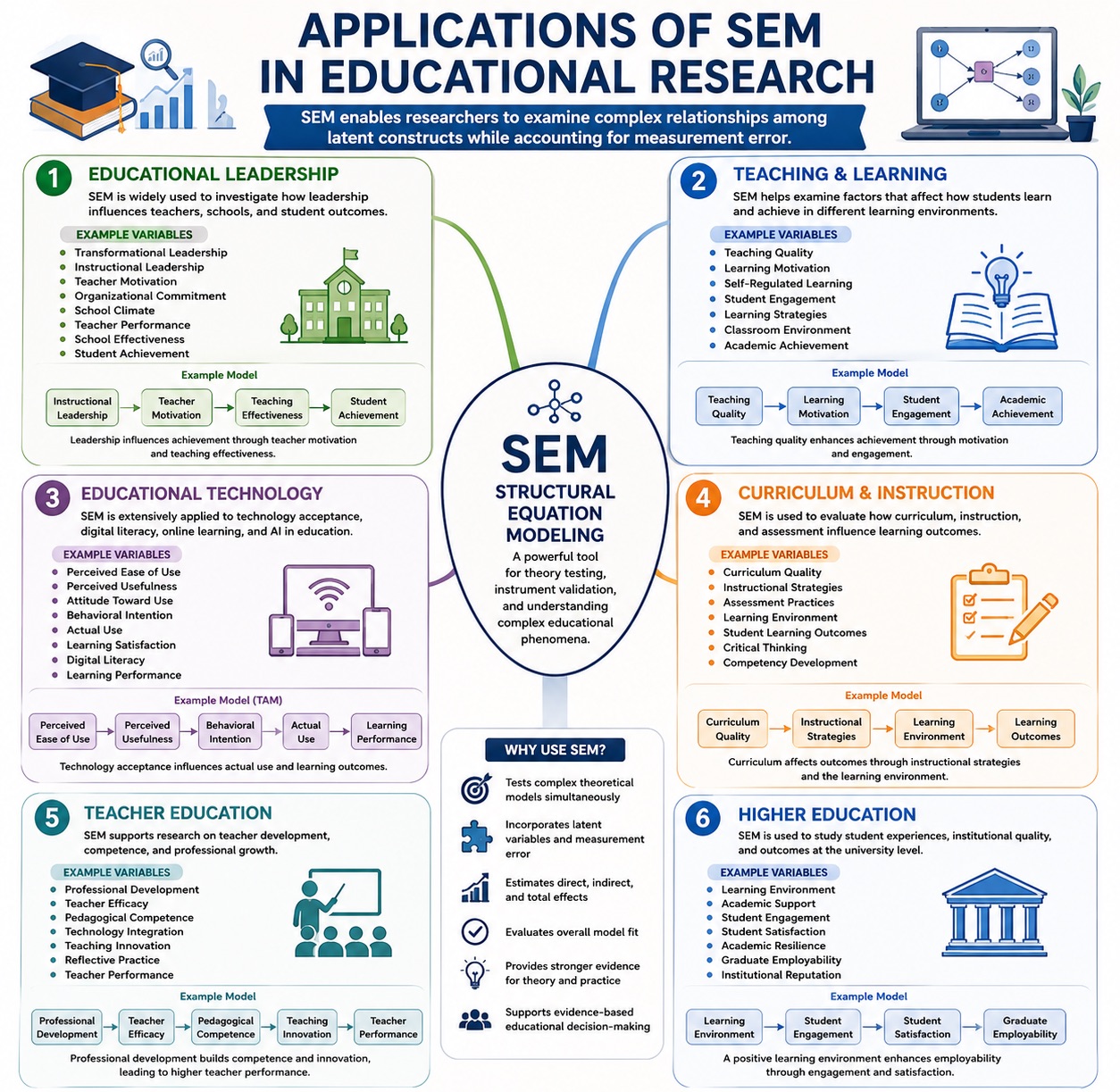
Figure 1.6 presents the major domains in which Structural Equation Modeling (SEM) is widely applied in educational research. Although each area focuses on different educational issues, they share common characteristics, including the investigation of latent constructs, complex causal relationships, and theory-driven research models. SEM enables researchers to validate measurement instruments and examine multiple relationships simultaneously, making it particularly suitable for contemporary educational studies.
Rresearchers increasingly adopt SEM because it allows them to examine multiple educational variables within a single theoretical framework while accounting for measurement error.
SEM is particularly useful when research involves:
- Latent constructs measured by multiple indicators.
- Complex causal relationships.
- Mediating or moderating variables.
- Theory testing and validation.
- Instrument validation through Confirmatory Factor Analysis (CFA).
These characteristics make SEM highly suitable for addressing contemporary educational research questions.
3. Major Areas of Application in Educational Research
SEM has been widely applied across various domains of educational research.
3.1 Educational Leadership
SEM is frequently used to investigate relationships among:
- Transformational leadership
- Instructional leadership
- Organizational commitment
- Teacher performance
- School effectiveness
Example Research Model
Instructional Leadership
           ↓
Teacher Motivation
           ↓
Teaching Effectiveness
           ↓
Student Achievement
3.2 Teaching and Learning
Researchers apply SEM to examine factors influencing learning outcomes.
Common variables include:
- Learning motivation
- Self-regulated learning
- Classroom engagement
- Teaching quality
- Academic achievement
Example
Teaching Quality
        ↓
Learning Motivation
        ↓
Student Engagement
        ↓
Academic Achievement
3.3 Educational Technology
SEM has become one of the most frequently used analytical methods in educational technology research.
Applications include:
- Technology Acceptance Model (TAM)
- Digital Literacy
- Artificial Intelligence in Education
- Online Learning
- Blended Learning
- Learning Management Systems (LMS)
Typical variables include:
- Perceived Ease of Use
- Perceived Usefulness
- Behavioral Intention
- Learning Satisfaction
- Learning Performance
3.4 Curriculum and Instruction
Researchers use SEM to investigate:
- Curriculum quality
- Teaching strategies
- Assessment practices
- Learning outcomes
- Competency development
SEM enables researchers to determine how curriculum implementation influences student achievement through mediating instructional variables.
3.5 Teacher Education
SEM is widely used in teacher education research.
Typical constructs include:
- Teacher efficacy
- Professional development
- Pedagogical competence
- Technology integration
- Teaching innovation
These constructs are often modeled as latent variables measured by multiple questionnaire items.
3.6 Higher Education
Applications include studies of:
- Student satisfaction
- Graduate employability
- Academic resilience
- Research competency
- Learning engagement
- University governance
- Quality assurance
4. Typical Educational Research Frameworks Using SEM
Several theoretical frameworks commonly employ SEM.
Examples include:
Technology Acceptance Model (TAM)
Perceived Ease of Use
↓
Perceived Usefulness
↓
Behavioral Intention
↓
Actual Use
Unified Theory of Acceptance and Use of Technology (UTAUT)
Performance Expectancy
↓
Behavioral Intention
↓
Technology Use
Student Engagement Model
Teaching Quality
↓
Learning Motivation
↓
Student Engagement
↓
Academic Achievement
Educational Leadership Model
Leadership
↓
Teacher Motivation
↓
Instructional Quality
↓
Student Performance
5. Benefits of Using SEM in Educational Research
SEM offers numerous advantages for educational researchers.
It enables researchers to:
- Validate educational measurement instruments.
- Examine relationships among multiple educational variables.
- Estimate direct, indirect, and total effects.
- Test complex conceptual frameworks.
- Reduce bias caused by measurement error.
- Improve theoretical explanations of educational phenomena.
- Provide stronger empirical evidence for educational policy and practice.
6. Example Research Topics Suitable for SEM
| Research Area | Example Topic |
|---|---|
| Educational Leadership | Leadership → Teacher Motivation → School Effectiveness |
| Educational Technology | Digital Literacy → Learning Engagement → Academic Achievement |
| Higher Education | Learning Environment → Student Satisfaction → Graduate Employability |
| Teacher Education | Professional Development → Teaching Competence → Teaching Innovation |
| Educational Psychology | Self-Efficacy → Learning Motivation → Academic Performance |
| Curriculum Studies | Curriculum Quality → Teaching Practice → Learning Outcomes |
7. When Should Educational Researchers Use SEM?
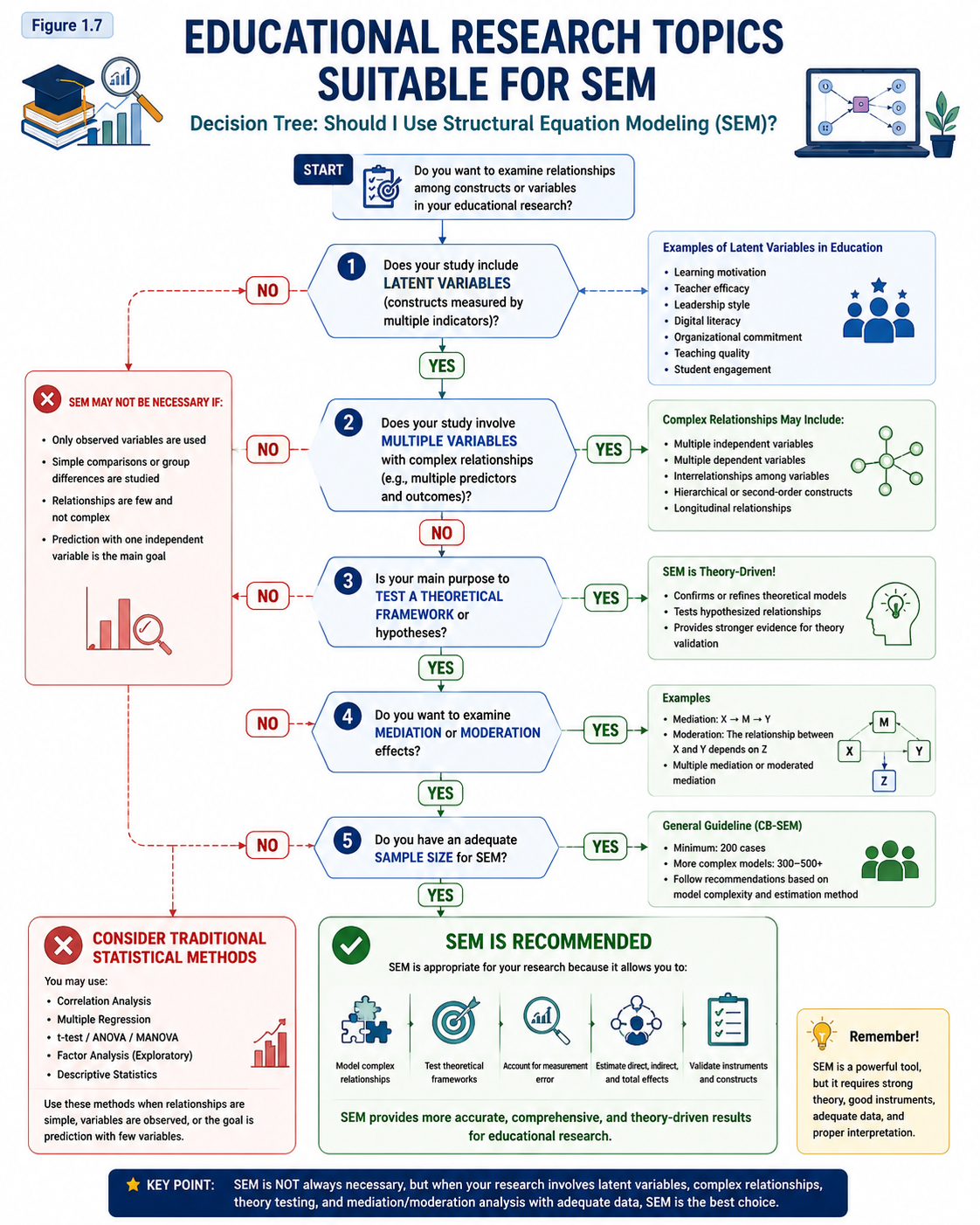
SEM is recommended when:
✅ The conceptual framework contains latent variables.
✅ Multiple causal relationships are examined simultaneously.
✅ Theory testing is the primary research objective.
✅ Mediation or moderation effects are investigated.
✅ Instrument validation is required.
SEM may not be appropriate when:
- The study contains only one independent variable and one dependent variable.
- Sample size is insufficient.
- The research is purely exploratory with no theoretical framework.
8. Key Takeaways
After completing this subchapter, learners should understand that:
- SEM has become one of the most important analytical methods in educational research.
- Educational constructs are frequently latent variables that require SEM for accurate measurement.
- SEM supports theory testing, instrument validation, and complex causal modeling.
- Educational leadership, educational technology, teacher education, curriculum studies, and educational psychology are among the fields that benefit most from SEM.
- Appropriate application of SEM contributes to more reliable educational research and evidence-based decision-making.
9. Reflection Questions
- Why are latent variables common in educational research?
- Which educational research topics are particularly suitable for SEM?
- How does SEM improve educational theory testing?
- Which conceptual framework in your own research could benefit from SEM?
- Under what circumstances would traditional statistical techniques be preferable to SEM?
📝 Suggested Readings (APA 7th)
- Byrne, B. M. (2022). Structural Equation Modeling with AMOS: Basic Concepts, Applications, and Programming (4th ed.). Routledge.
- Hair, J. F., Black, W. C., Babin, B. J., & Anderson, R. E. (2022). Multivariate Data Analysis (9th ed.). Cengage.
- Kline, R. B. (2023). Principles and Practice of Structural Equation Modeling (5th ed.). Guilford Press.
- Schumacker, R. E., & Lomax, R. G. (2022). A Beginner's Guide to Structural Equation Modeling (5th ed.). Routledge.
2. Fundamental Concepts in Structural Equation Modeling
2.1. Variables in SEM
2.2. Observed Variables
2.3. Latent Variables
2.4. Exogenous Variables
2.5. Endogenous Variables
2.6. Measurement Error
2.7. Residual Error and Disturbance Terms
3. Components of Structural Equation Modeling
3.1. Measurement Model
3.2. Structural Model
3.3. Path Diagram
3.4. Model Parameters
3.5. Factor Loadings
3.6. Regression Weights
3.7. Covariance and Correlation
4. Types of Structural Equation Models
4.1. Path Analysis
4.2. Confirmatory Factor Analysis (CFA)
4.3. Full Structural Equation Modeling
4.4. Mediation Model
4.5. Moderation Model
4.6. Higher-Order Factor Model
4.7. Multi-Group SEM
5. Assumptions of Structural Equation Modeling
5.1. Sample Size Requirements
5.2. Multivariate Normality
5.3. Linearity
5.4. Independence of Observations
5.5. Multicollinearity
5.6. Missing Data
5.7. Outliers
6. The Structural Equation Modeling Process
6.1. Developing a Conceptual Framework
6.2. Formulating Research Hypotheses
6.3. Questionnaire Development
6.4. Data Collection
6.5. Data Screening
6.6. Model Specification
6.7. Model Estimation
6.8. Model Evaluation
6.9. Model Modification
6.10. Interpretation of Results
7. SEM Software
7.1. IBM SPSS AMOS
7.2. LISREL
7.3. Mplus
7.4. SmartPLS
7.5. R (lavaan Package)
7.6. Stata SEM
8. Summary and Preparation for Advanced SEM
8.1. Key Concepts Review
8.2. Common Mistakes in SEM
8.3. Preparing for Confirmatory Factor Analysis
8.4. Chapter Summary