Q&A – Media and Learning Resources

Q&A – Media and Learning Resources

โดย Dr.Jim Panjarattanakorn -
Number of replies: 5


🟠 Please answer the two questions below based on your understanding of the slide content and class discussion:

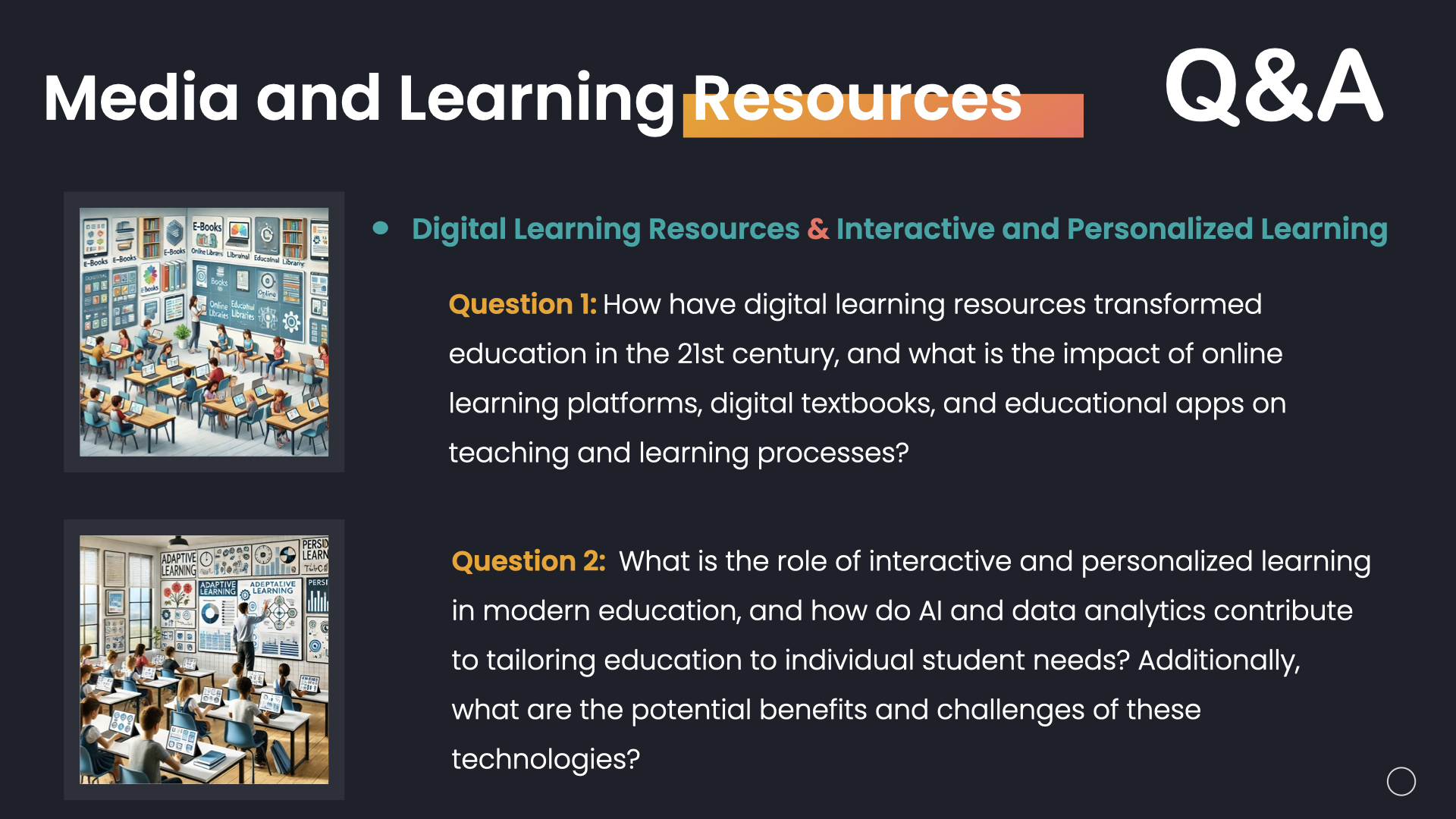
Question 1:
How have digital learning resources transformed education in the 21st century, and what is the impact of online learning platforms, digital textbooks, and educational apps on teaching and learning processes?

Question 2:
What is the role of interactive and personalized learning in modern education, and how do AI and data analytics contribute to tailoring education to individual student needs? Additionally, what are the potential benefits and challenges of these technologies?

📌 After submitting your answers, reply to at least one of your peers' posts to foster discussion.


In reply to Dr.Jim Panjarattanakorn

Re: Q&A – Media and Learning Resources

โดย Muhammad Zuhair Ali -

Q1) How have digital learning resources transformed education in the 21st century, and what is the impact of online learning platforms, digital textbooks, and educational apps on teaching and learning processes?

Answer:

Digital learning resources have significantly transformed education in the 21st century by making learning more accessible, interactive, and flexible.

Online platforms, digital textbooks, and educational digital applications have altered how teachers deliver content and how students engage with it.

These tools support self-paced learning, provide instant feedback, and offer a wide range of multimedia content to adapt diverse learning styles. As a result, teaching has become more dynamic, and students can learn anytime and anywhere, improving both engagement and understanding.

In reply to Dr.Jim Panjarattanakorn

ตอบ: Q&A – Media and Learning Resources

โดย กัญจน์ธนธัญ วงศ์สีชิน -

How have digital learning resources transformed education in the 21st century, and what is the impact of online learning platforms, digital textbooks, and educational apps on teaching and learning processes?

1. Digital Learning Resources

E-Books and Online Libraries

  • Instant access to vast academic materials
  • Interactive multimedia elements that enhance understanding
  • Cost-effective alternative to traditional textbooks
  • Searchable content for efficient information retrieval

Educational Apps and Software

  • Interactive exercises, games, and quizzes making learning engaging
  • Subject-specific tools supporting various disciplines
  • Gamification elements that motivate students through points, badges, and leaderboards

2. Online Learning Platforms

  • Accessibility: Learning anytime, anywhere
  • Scalability: Reaching larger student populations
  • Personalization: Customized learning paths
  • Global reach: Connecting students worldwide

Impact on Teaching and Learning Processes

For Students:

  • Self-paced learning accommodating different learning speeds
  • Multiple learning modalities (visual, auditory, kinesthetic)
  • Immediate feedback through interactive assessments
  • Collaborative opportunities through online discussion forums

For Teachers:

  • Enhanced instructional tools with multimedia capabilities
  • Data analytics to track student progress and identify learning gaps
  • Flexible content delivery methods
  • Professional development through online resources

For Educational Institutions:

  • Cost reduction in physical materials and infrastructure
  • Expanded reach to non-traditional students
  • Improved resource management through digital platforms
  • Enhanced administrative efficiency

Key Benefits

Adaptive Learning Technologies

  • Personalized content based on individual student needs
  • Data-driven insights for educational improvement
  • Continuous assessment and adjustment of learning paths

Interactive and Engaging Learning

  • Gamification increases student motivation
  • Multimedia integration appeals to different learning styles
  • Real-time collaboration tools enhance peer learning

Challenges and Considerations

Digital Divide

  • Technology access disparities among students
  • Internet connectivity requirements
  • Digital literacy skill gaps

Quality Assurance

  • Content credibility and accuracy concerns
  • Pedagogical effectiveness of digital tools
  • Student engagement maintenance in digital environments

In reply to Dr.Jim Panjarattanakorn

回复: Q&A – Media and Learning Resources

โดย Peng Bin -
Q1)数字学习资源如何改变了 21 世纪的教育,在线学习平台、数字教科书和教育应用程序对教学过程有什么影响?
教育资源的丰富与共享:数字学习资源极大地丰富了教育资源的种类和数量,打破了传统教育资源的时空限制,实现了优质教育资源的广泛共享。学习方式的变革:数字学习资源使学习方式更加多样化和个性化,学生可以根据自己的学习进度和兴趣选择适合自己的学习内容和方式。教育理念的更新:数字学习资源推动了教育理念的更新,促使教育从传统的以教师为中心向以学生为中心转变。在线学习平台对教学过程的影响教学模式的创新:在线学习平台为教学提供了更加灵活多样的模式,如混合式教学、翻转课堂等。
数字教科书对教学过程的影响内容呈现的多样化:数字教科书不仅包含传统的文字和图片,还可以嵌入音频、视频、动画等多种媒体形式。学习互动的增强:数字教科书支持学生之间的互动学习,学生可以在教科书上进行批注、讨论和分享。• 知识更新的及时性:数字教科书可以方便地进行内容更新,及时反映学科领域的最新研究成果和知识进展。教育应用程序对教学过程的影响学习的便捷性:教育应用程序可以在移动设备上使用,学生可以随时随地进行学习。这种便捷性使得学习不再局限于课堂和学校,学生可以在课余时间、旅行途中等任何时间地点进行学习。习的趣味性:教育应用程序通常采用游戏化、互动化的学习方式,使学习变得更加有趣和吸引人。技能培养的针对性:教育应用程序可以根据不同的学习目标和需求,提供针对性的技能训练和练习。
In reply to Dr.Jim Panjarattanakorn

Re: Q&A – Media and Learning Resources

โดย Muhammad Zuhair Ali -

Q2) What is the role of interactive and personalized learning in modern education, and how do AI and data analytics contribute to tailoring education to individual student needs? Additionally, what are the potential benefits and challenges of these technologies?


Answer:

Interactive and personalized learning play a vital role in modern education by making the learning experience more engaging, student-centered, and adaptive to individual needs. Unlike traditional standardized models, personalized learning allows students to learn at their own pace, style, and ability level. Interactive tools such as simulations, gamified platforms, and multimedia resources foster active participation, deeper understanding, and greater motivation.

Artificial intelligence (AI) and data analytics enhance this personalization by analyzing learners performance, behavior, and preferences in real time. These technologies can recommend learning paths, identify learning gaps, and provide instant feedback, helping educators adjust instruction to support each learner more effectively. For example, AI-powered platforms can deliver targeted practice exercises or suggest resources tailored to a student’s progress.

However, while the benefits include improved engagement, efficiency, and learning outcomes, there are also challenges. These include concerns about data privacy, the digital divide, over-reliance on technology, and the need for proper teacher training. To be truly effective, AI and data tools must be used ethically and thoughtfully, ensuring they complement and not replace the essential human role in education.

In reply to Dr.Jim Panjarattanakorn

Re: Q&A – Media and Learning Resources

โดย Yangin Hu -

Question 1:
How have digital learning resources transformed education in the 21st century, and what is the impact of online learning platforms, digital textbooks, and educational apps on teaching and learning processes?

Answer: Digital learning resources have significantly transformed education in the 21st century by reshaping how knowledge is accessed, delivered, and consumed. These tools—such as online learning platforms, digital textbooks, and educational apps—have had profound effects on both teaching and learning processes.

1. Accessibility and Flexibility  2. Personalized and Adaptive Learning  3. Enhanced Engagement and Interactivity  4. Teacher Empowerment and Efficiency  5. Global Reach and Lifelong Learning  6. Cost and Sustainability Benefits

Digital learning resources have revolutionized education by making it more accessible, personalized, and engaging. They support modern pedagogical approaches and foster skills necessary for the 21st-century workforce.

Question 2:

What is the role of interactive and personalized learning in modern education, and how do AI and data analytics contribute to tailoring education to individual student needs? Additionally, what are the potential benefits and challenges of these technologies?

Answer: Interactive and personalized learning play a central role in modern education, aiming to move beyond the traditional one-size-fits-all approach and create more engaging, relevant, and effective learning experiences for each student. Technologies such as artificial intelligence (AI) and data analytics are key enablers of this shift.

1. Role of Interactive and Personalized Learning
Interactive Learning
Active Participation: Involves students in activities like quizzes, simulations, group discussions, and games that foster engagement and retention.
Immediate Feedback: Helps learners quickly understand their mistakes and correct them.
Collaboration and Communication: Encourages peer-to-peer learning and builds teamwork skills using platforms like Zoom, Microsoft Teams, or Google Classroom.
Personalized Learning
Learner-Centered Approach: Instruction is adapted to students’ learning pace, interests, strengths, and challenges.
Flexible Pathways: Students can choose learning modules or formats (video, text, audio) that suit their preferences and needs.
Improved Motivation: Personalized goals and progress tracking help maintain student motivation and accountability.

2. Contribution of AI and Data Analytics
Artificial Intelligence
Intelligent Tutoring Systems: AI tutors (e.g., Carnegie Learning) provide real-time guidance, hints, and explanations.
Natural Language Processing (NLP): Helps in grading essays, answering student queries, and improving communication in multiple languages.
Predictive Analytics: AI can forecast a student’s performance based on past behavior and suggest interventions.