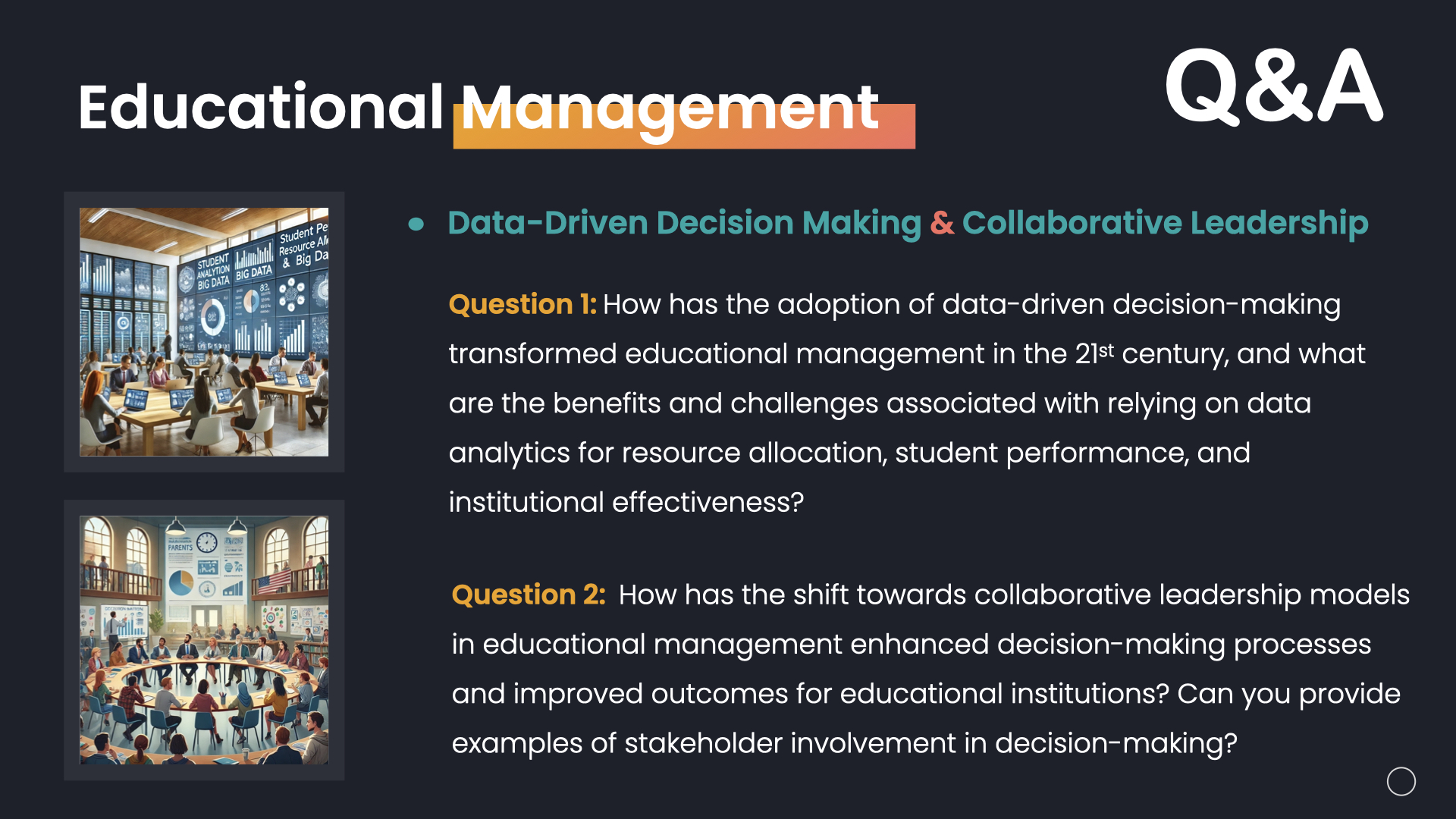
Q1: Data-Driven Decision Making in Educational
Management
The implementation of data-driven decision-making has
significantly altered educational management in the 21st century by allowing
institutions to make more well-versed, strategic, and measurable decisions. By utilizing
data analytics; educational institutions can allocate resources more
efficiently, identify trends in student performance, and monitor institutional
progress with more accuracy. This results in targeted interventions, improved
academic outcomes, and better use of funding and staff development.
However, the integration of data also brings challenges; these
include concerns over data privacy, the risk of over-reliance on quantitative
metrics, and the potential for misinterpreting data without proper context or
expertise. This can result in flawed conclusions or misguided policies that do
not exactly reflect the needs of the educational institutions. To address these
issues, educational leaders must approach data utilization thoughtfully,
ensuring it supports a holistic and balanced view of teaching and learning.
Also, not all institutions have equal access to advanced
data systems, creating disproportions in implementation. Despite these
challenges, when used ethically and thoughtfully, data analytics can support
continuous development and assist leaders in making decisions those are
transparent, equitable, and results-oriented.
Q2: Collaborative Leadership in Educational Management
The shift toward collaborative leadership has significantly
improved decision-making processes within current educational institutions.
Unlike traditional top-down leadership models, where decisions are made by a
small team of administrators, whereas collaborative leadership encourages shared
responsibility and inclusive participation among a broader range of
stakeholders, including administrators, teachers, students, parents, and
community members.
This approach fosters
a culture of transparency, mutual trust, and collective ownership, empowering
all members of the educational community to contribute their insights and take
part in shaping the institution’s direction. As a result, educational
institutions are more likely to develop innovative, practical, and sustainable
solutions to the challenges they face.
Collaborative leadership leads to better
educational outcomes by valuing diverse perspectives and lived experiences,
which strengthens the relevance and effectiveness of institutional policies and
programs. For example, involving parents in school improvement initiatives
ensures that family perspectives are considered, while student advisory panels
provide direct input from the learners themselves, increasing engagement and
satisfaction. Similarly, teacher-led committees on curriculum development or
resource management bring frontline experience into strategic discussions,
ensuring decisions reflect real classroom needs. Encouraging meaningful
participation at multiple levels, educational institutions become more agile,
inclusive, and capable of responding effectively to changing demands; eventually
promoting equity, empowerment, and long-term institutional success.