Questions about the Population Dimension

Questions about the Population Dimension

PanjarattanakornDr.Jim -
回帖数:9


Please answer at least one of the following questions. Feel free to provide real-world examples, case studies, or data to support your answers.

These are the questions for you to choose.

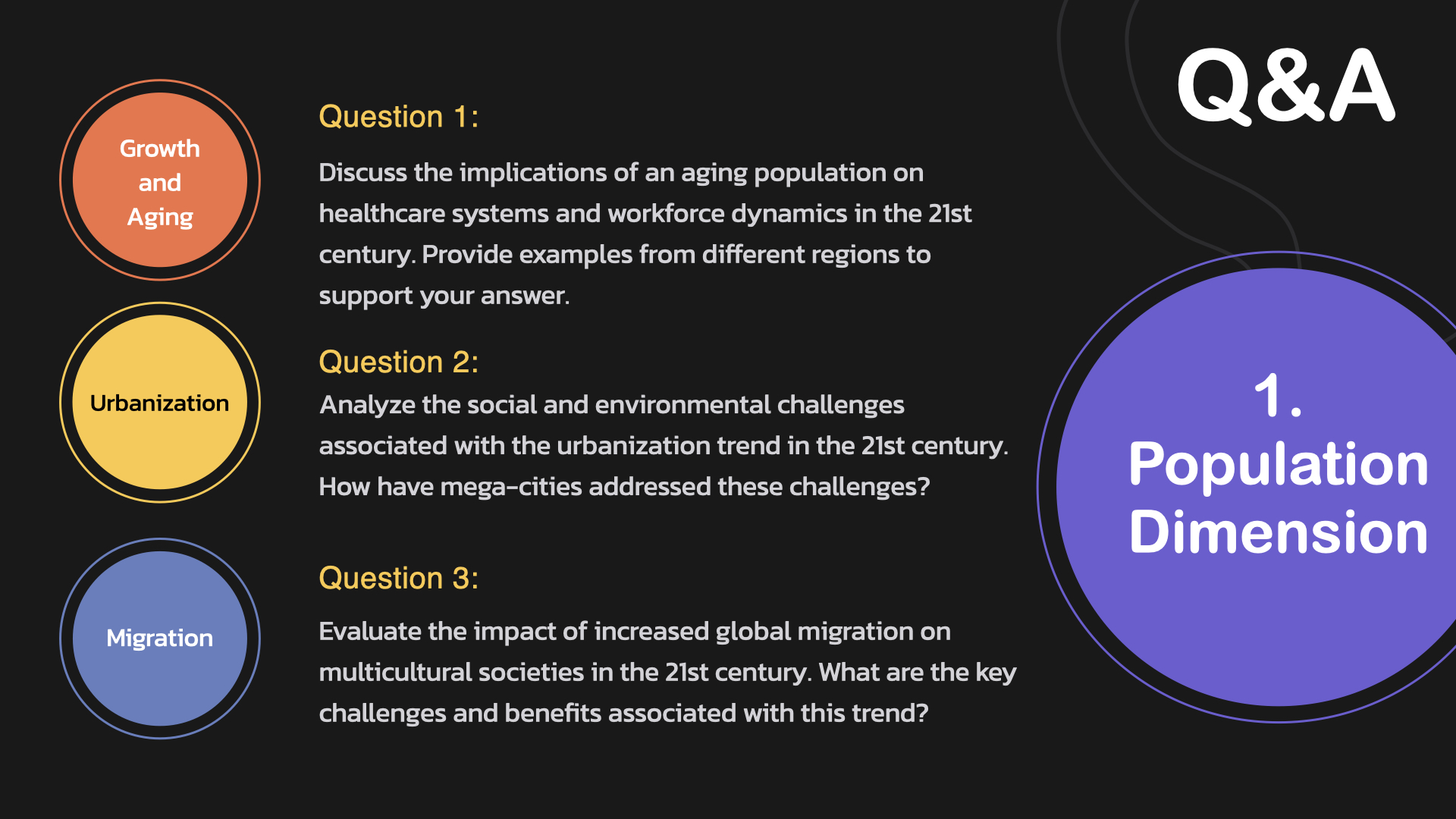
Question 1: Discuss the implications of an ageing population on healthcare systems and workforce dynamics in the 21st century. Provide examples from different regions to support your answer.

Question 2: Analyze the social and environmental challenges associated with the urbanization trend in the 21st century. How have mega-cities addressed these challenges?

Question 3: Evaluate the impact of increased global migration on multicultural societies in the 21st century. What are the key challenges and benefits associated with this trend?

📌 Instructions:

  • Reply with your response in this Population Dimension forum.
  • Use approximately 150–200 words
  • You may include relevant images, data, or links
  • I’m Looking forward to reading your thoughtful and critical responses!

回复PanjarattanakornDr.Jim

ตอบ: Questions about the Population Dimension

Question 2: Analyze the social and environmental challenges associated with urbanization trends in the 21st century. How have mega-cities addressed these challenges?

Answer: Urbanization in the 21st century poses significant social and environmental challenges. Socially, rapid urban growth leads to overcrowding, a lack of affordable housing, and increased social inequality. It can also strain existing infrastructure, such as transportation and sanitation systems, and contribute to higher crime rates and feelings of social alienation.

Environmentally, urbanization results in increased air and water pollution, destruction of green spaces, and a rise in carbon emissions. Uncontrolled urban sprawl also damages natural ecosystems and reduces biodiversity.

Mega-cities have attempted to address these challenges through various methods:

1. Sustainable housing development: Cities like Singapore have invested in building affordable and energy-efficient housing to accommodate growing populations.

2. Public transportation: Cities such as Tokyo and London have developed comprehensive public transportation systems to reduce reliance on private cars and mitigate pollution.

3. Green spaces and urban planning: Cities like Vancouver have integrated green spaces and parks into urban planning to improve air quality and promote residents' well-being.

4. Waste management: Many large cities are implementing recycling programs and waste-to-energy technologies to manage increasing volumes of waste.
回复วงศ์สีชินกัญจน์ธนธัญ

ตอบ: Questions about the Population Dimension

How Mega-Cities Are Addressing These Challenges through Innovative Education
Mega-cities around the world have begun integrating innovative education strategies as a core solution to tackle these issues:

1. Smart Education Systems:
Cities like Seoul and Singapore have integrated smart classrooms, AI-driven learning platforms, and digital infrastructure to reduce educational inequality.

Blended learning allows access to quality education even in underserved urban areas.

2. Urban Sustainability Curriculum:
Cities such as Amsterdam and Tokyo have incorporated environmental education into their school systems, teaching students about climate change, sustainability, and waste reduction from a young age.

Green schools promote eco-friendly practices and use campuses as living laboratories for sustainability.

3. Lifelong Learning for Urban Resilience:
Cities are encouraging community education centers, vocational training, and online micro-credentials to upskill urban populations, especially marginalized groups.

Programs like UNESCO’s Learning Cities (e.g., Shanghai, Medellín) offer platforms for inclusive, equitable, and sustainable learning opportunities across all ages.

4. Education for Social Cohesion:
Innovative education also includes promoting civic education, cultural sensitivity, and digital literacy, helping diverse urban communities understand and respect one another.

Service-learning and community-based projects connect students with real urban issues, building empathy and social responsibility.

5. Data-Driven Urban Education Policies:
Using big data and learning analytics, some cities are mapping learning needs to better allocate resources, improve dropout rates, and anticipate future skill demands.

回复PanjarattanakornDr.Jim

Re: Questions about the Population Dimension

PhophetDr.Vinutthaput -

Population change significantly impacts education by altering the demand for educational resources, infrastructure, and planning. An increasing population, especially in urban areas, can lead to overcrowded classrooms, teacher shortages, and strain on school facilities, affecting the quality of education. Conversely, a declining or aging population may result in school closures, reduced funding, and limited educational opportunities in rural or less populated regions. Shifts in population demographics, such as migration or rising birth rates, also require adjustments in curriculum, language support, and inclusive policies to meet diverse student needs. Therefore, educational systems must continuously adapt to these changes to ensure equitable access and quality learning for all.

回复PanjarattanakornDr.Jim

ตอบ: Questions about the Population Dimension

ชานวิทิตกุลอัปสร -
The elderly population is increasingly experiencing complications from illness and physical deterioration, leading to an increased demand for health services and care.
回复ชานวิทิตกุลอัปสร

Re: ตอบ: Questions about the Population Dimension

PanjarattanakornDr.Jim -
The ways to link this to education:

1. Curriculum Development in Health and Gerontology

Educational institutions can design and implement specialized programs or courses in gerontology, elderly care, and community health to prepare professionals (e.g., nurses, caregivers, social workers, health educators) to meet the rising demand.

2. Lifelong Learning and Health Literacy

Promote health education programs for the elderly population to enhance their health literacy, self-care skills, and ability to manage chronic conditions.

3. Training for Caregivers and Family Members

Offer short-term certification programs or community workshops aimed at training informal caregivers (e.g., family members) in elder care and first aid.

4. Education Policy for an Aging Society

Educational administrators and policy makers must adapt policies to address workforce shortages in elderly care, by supporting scholarships and incentives for students entering geriatric-related fields.

5. Intergenerational Education Programs

Promote intergenerational learning where younger students engage in service-learning projects with the elderly, fostering empathy, communication, and mutual support.
回复PanjarattanakornDr.Jim

Re: ตอบ: Questions about the Population Dimension

HuYangin -
Intensifying aging: The population in many countries is aging rapidly, which has led to a greater emphasis on lifelong education, education for the elderly, and vocational retraining in education policies。

Declining birth rate: Schools are facing the problem of decreasing student enrollment, and schools in some areas are merging or reducing educational resources.


回复HuYangin

Re: ตอบ: Questions about the Population Dimension

PanjarattanakornDr.Jim -

How to Link Urbanization Challenges to Education

The trend of urbanization has led to excessive concentration of urban population, resulting in tight urban housing, overloaded infrastructure, traffic congestion, uneven resource distribution, and difficulty in popularizing public services. At the same time, it has brought air and water pollution, excessive garbage, and a sharp increase in energy consumption to cities.

➡️ These urbanization-related problems create both challenges and opportunities for the education sector in the following ways:


1. Curriculum Integration and Environmental Education

Urbanization introduces pressing environmental and sustainability issues. Schools and universities can integrate urban planning, environmental science, and sustainable development into the curriculum to prepare students as future problem-solvers and informed citizens.


2. Equity in Educational Access

Urban overcrowding and uneven resource distribution often result in education inequality—especially in slums or underserved areas. Educational leaders must design targeted policies and resource allocation to ensure access to quality education for all, including migrant children and low-income urban families.


3. Promoting Lifelong Learning for Urban Resilience

With the rapid pace of change in cities, adult education and lifelong learning programs are critical to equip urban residents with knowledge about public health, environmental protection, smart city technologies, and community participation.


4. Infrastructure Planning for Educational Institutions

Urban congestion and overloaded infrastructure require careful planning of school locations, transportation systems, and digital learning alternatives. Schools may need to adopt hybrid or online models to reach students more effectively in dense urban settings.


5. Raising Civic Awareness and Urban Citizenship

Education plays a role in building civic responsibility and awareness among students about sustainable urban living, waste reduction, energy saving, and participatory urban governance.

回复PanjarattanakornDr.Jim

Re: Questions about the Population Dimension

AliMuhammad Zuhair -
Q1: Discuss the implications of an aging population on healthcare systems and workforce dynamics in the 21st century. Provide examples from different regions to support your answer.


Answer In Context of the Question:

In the 21st Century, the global population is aging at an unprecedented rate due to declining fertility and increased life expectancy. This demographic shift poses significant challenges for the healthcare systems and workforce sustainability.

Healthcare System:
An aging population leads to a rising prevalence of chronic illnesses which requires long-term and specialized care. Country like Japan and Italy has more than 28% of population over 65, which is directly proportional to the increased in healthcare expenditure and shortages in the healthcare professionals. To tackle this issue, Japan has pioneered the use of robotics and AI in the medical diagnosis to reduce the dependency on human labor.


Workforce Dynamics:
An aging workforce reduces the proportion of working age individuals, leading to labor shortage and higher dependencies ratios. In Germany, the government has implemented pension reforms and encouraged older workers to stay employed longer.

In Thailand, it is facing a shirking labor pool and has begun to consider skilled immigration as a solution to sustain economic productivity.

The combination of state-of-art healthcare needs and fewer working taxpayers threatens the financial stability of social security system globally. Addressing these challenges requires mix of technological innovation, policy reform, and inclusive workforce planning.


In The Context of Education Industry:

Aging Population Impact on Education:
Strain or demand on education systems. Needs for inclusive policies; such as elderly education, migrant students specialized programs to cater this niche. Also, changes in the curriculum to reflect on demographics shift.
回复PanjarattanakornDr.Jim

回复: Questions about the Population Dimension

CaoBin -
The issue of the population dimension will have a profound impact on economic development, social welfare, resources and the environment, etc., and requires all countries to formulate corresponding policies to actively respond.