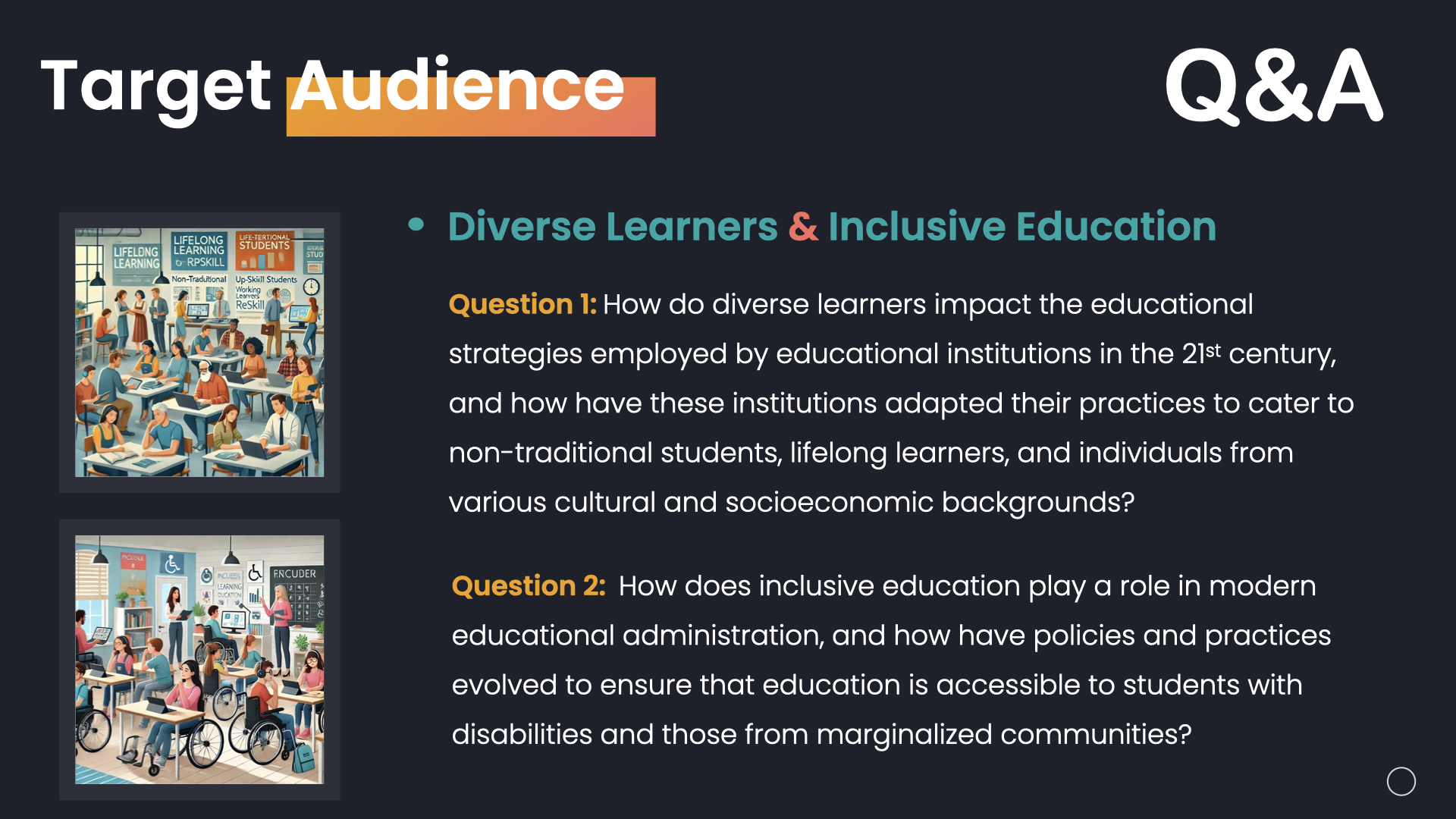
1.How do diverse learners impact the educational strategies employed by educational institutions in the 21st century, and how have these institutions adapted to cater to non-traditional students, lifelong learners, and individuals from various cultural and socioeconomic backgrounds?
AN: In the 21st century, diverse learners have brought about profound changes in the educational strategies of educational institutions. Firstly, the needs of diverse learners have led educational institutions to abandon the traditional one-size-fits-all teaching model. They now adopt more flexible and personalized educational strategies. For example, for non-traditional students such as adult learners, institutions offer more part-time courses, online learning options, and accelerated degree programs to accommodate their work and family responsibilities. For lifelong learners, educational institutions have established a variety of continuing education programs, including short-term training courses, vocational skill upgrading courses, and online micro-credential programs. These programs allow learners to continuously update their knowledge and skills according to changes in the job market and personal interests. In terms of students from different cultural and socioeconomic backgrounds, educational institutions have implemented multicultural education strategies. They incorporate multicultural content into the curriculum, such as offering courses on world cultures, ethnic studies, and cross-cultural communication. At the same time, they provide targeted support for students from low-income families, such as scholarships, grants, and academic tutoring, to ensure they have equal access to educational opportunities. In addition, educational institutions have also improved their teaching methods and assessment methods. They use more interactive teaching methods, such as group discussions, project-based learning, and case studies, to meet the learning needs of students with different learning styles. In terms of assessment, they adopt diversified assessment methods, such as portfolios, presentations, and practical assessments, to comprehensively evaluate students' learning outcomes. In summary, diverse learners have driven educational institutions to continuously innovate and improve their educational strategies. By providing personalized, flexible, and multicultural education, educational institutions can better meet the needs of different learners and promote educational equity and social development.
2.How does inclusive education play a role in modern educational administration, and how have policies and practices evolved to ensure accessibility for students with disabilities and those from marginalized communities?
AN: Inclusive education has become a cornerstone of modern educational administration, serving as both a moral imperative and a strategic framework to advance equity, social cohesion, and systemic efficiency. Its role in educational administration is multifaceted:
First, it redefines the core purpose of education from "selective excellence" to "universal participation," pushing administrators to design systems that prioritize accessibility over exclusion. This shift requires reallocating resources—from funding and facilities to teacher training—toward removing barriers, whether physical, curricular, or attitudinal. For example, administrators must now ensure schools are wheelchair-accessible, curricula are adaptable for diverse learning needs, and staff are trained to address bias, all of which restructures how educational institutions are planned, resourced, and evaluated.
Second, inclusive education fosters systemic accountability. Modern educational administration increasingly ties performance metrics to equity outcomes, such as enrollment rates of students with disabilities or marginalized backgrounds, dropout rate disparities, and academic progress for all subgroups. This pushes administrators to move beyond "one-size-fits-all" policies and adopt targeted interventions, making inclusion a key lens for decision-making.
Third, it strengthens social integration by embedding diversity into the fabric of schooling. By ensuring students with disabilities, ethnic minorities, or socioeconomic disadvantages learn alongside their peers, educational institutions become microcosms of inclusive societies, equipping all students with empathy and collaboration skills—critical for 21st-century citizenship. Administrators, in turn, must coordinate with community organizations, families, and policymakers to align school practices with broader social inclusion goals.
Practice Adaptations:
Curricular and Pedagogical Shifts: Schools now use differentiated instruction, universal design for learning (UDL), and assistive technologies (e.g., screen readers, sign language interpreters) to make content accessible. For marginalized communities, culturally responsive teaching—incorporating local languages, histories, and values—reduces alienation and improves engagement.
Support Systems: Individualized Education Programs (IEPs) for students with disabilities and targeted mentorship programs for marginalized youth (e.g., first-generation students) ensure personalized support. Administrators also train teachers in inclusive practices, often partnering with special educators and community leaders to build capacity.
Infrastructure and Access: Physical barriers are being removed through ramps, elevators, and sensory-friendly classrooms. Digital accessibility—such as captioning for online lessons—has expanded post-pandemic, ensuring remote learning does not exclude students with disabilities.
Community Engagement: Schools now collaborate with families from marginalized backgrounds through multilingual communication, culturally sensitive outreach, and parent advocacy workshops, recognizing families as partners in inclusion rather than passive recipients.