Q&A – Target Audience

Q&A – Target Audience

โดย Dr.Jim Panjarattanakorn -
Number of replies: 10


Please respond to the following two questions based on what you have learned from the slides and class discussion:

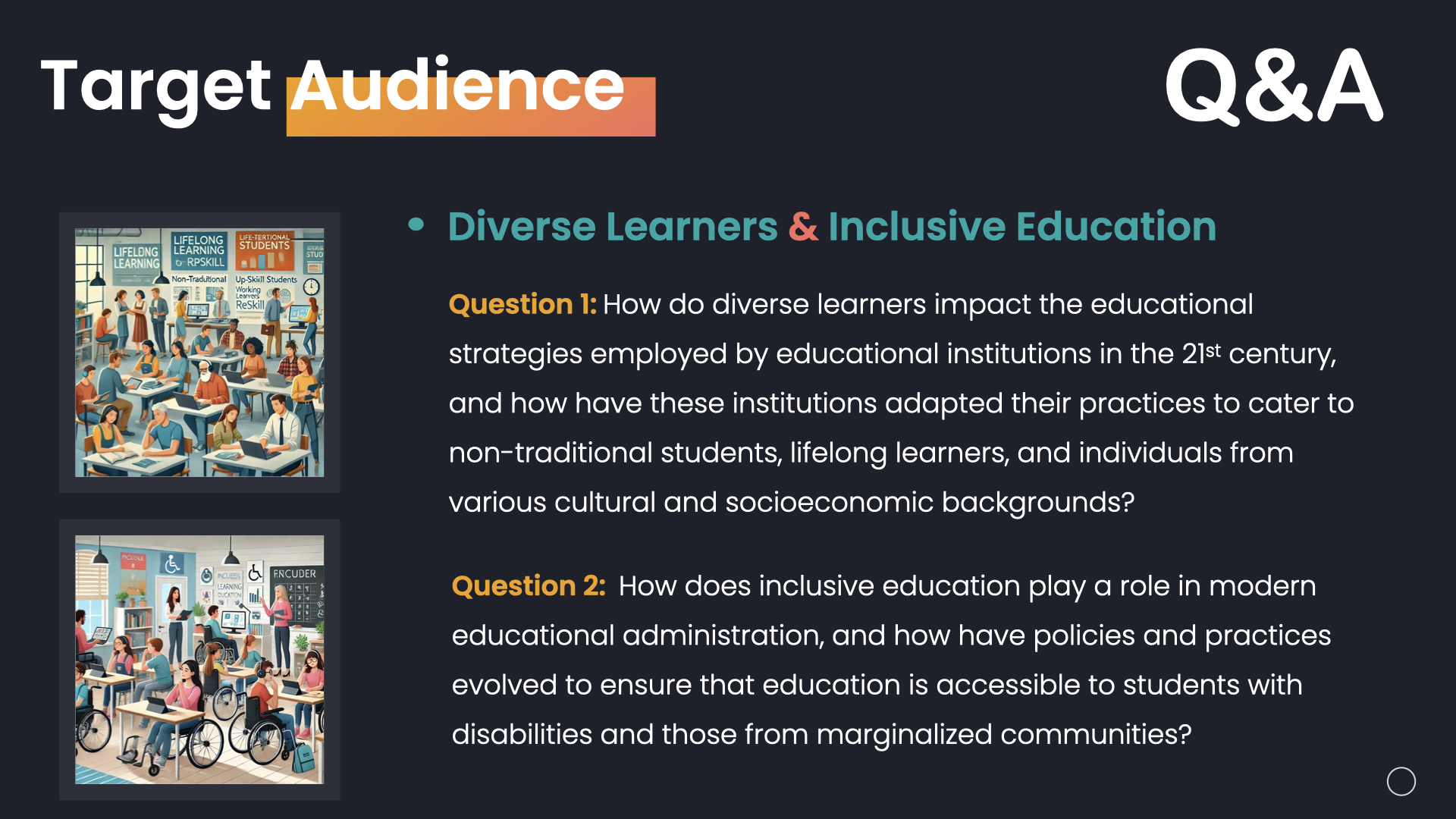
  1. How do diverse learners impact the educational strategies employed by educational institutions in the 21st century, and how have these institutions adapted to cater to non-traditional students, lifelong learners, and individuals from various cultural and socioeconomic backgrounds?

  2. How does inclusive education play a role in modern educational administration, and how have policies and practices evolved to ensure accessibility for students with disabilities and those from marginalized communities?

After posting your answers, please read and comment on at least one of your peers' responses.


In reply to Dr.Jim Panjarattanakorn

ตอบ: Q&A – Target Audience

โดย อัปสร ชานวิทิตกุล -


  1. How does a diverse student population impact the educational strategies that institutions employ in the 21st century, and how are these institutions adapting to accommodate non-traditional students, lifelong learners, and individuals from diverse cultural and socioeconomic backgrounds?

1.Differentiated Instruction:
Teachers must adapt their teaching methods to accommodate the different abilities, aptitudes, and learning styles of each student.

2.Inclusive Curriculum:

The curriculum should be diverse in content, perspectives, and learning materials to reflect the diversity of cultures, experiences, and interests of students.

In reply to Dr.Jim Panjarattanakorn

Re: Q&A – Target Audience

โดย Muhammad Zuhair Ali -
Q1) How do diverse learners impact the educational strategies employed by educational institutions in the 21st century, and how have these institutions adapted to cater to non-traditional students, lifelong learners, and individuals from various cultural and socioeconomic backgrounds?

Answer:

In the current educational landscape, the institutions can not relay on traditional learning, the generic approach. The rapid growing presence of diverse learners; including non-traditional students, lifelong learners and individuals from various cultural and socioeconomic backgrounds has pushed the education system to advance and evolve.

The educational institutions have responded by adopting more flexible teaching methodologies, embracing technology and generating inclusive learning environments that recognize and respect individual differences.

These advancements are not just about meeting educational needs but also, they tend to create opportunities. Through online learning, culturally responsive teaching, or support services that address financial and social barriers, institutions are working to ensure that education is accessible and meaningful for everyone. Ultimately, by adapting to this diversity, educational systems are becoming more reasonable, relevant, and prepared to serve learners of all kinds in the 21st century.
In reply to Dr.Jim Panjarattanakorn

ตอบ: Q&A – Target Audience

โดย กัญจน์ธนธัญ วงศ์สีชิน -

How do diverse learners impact the educational strategies employed by educational institutions in the 21st century, and how have these institutions adapted to cater to non-traditional students, lifelong learners, and individuals from various cultural and socioeconomic backgrounds?

1. Non-Traditional Students

Educational institutions have had to fundamentally restructure their delivery methods to accommodate:

  • Adult learners who balance work and family responsibilities
  • Working professionals seeking career advancement
  • Individuals pursuing reskilling or upskilling due to rapidly changing job markets

Institutional Adaptations:

  • Implementation of flexible learning options including evening classes
  • Development of online courses and hybrid learning models
  • Creation of part-time programs that allow students to maintain employment
  • Design of modular curricula that can be completed at varying paces

2. Lifelong Learners

The emphasis on continuous education has led institutions to:

  • Develop continuous learning pathways rather than traditional degree-only programs
  • Create micro-credentials and certificate programs
  • Establish alumni engagement programs for ongoing professional development
  • Partner with employers to provide workplace learning opportunities

3. Cultural and Socioeconomic Diversity

Institutions have adapted by:

  • Addressing barriers to participation through financial aid and support services
  • Providing equitable access to quality education regardless of background
  • Incorporating culturally responsive teaching methods
  • Developing multilingual resources and support systems.

In reply to Dr.Jim Panjarattanakorn

回复: Q&A – Target Audience

โดย Bo Deng -

1.How do diverse learners impact the educational strategies employed by educational institutions in the 21st century, and how have these institutions adapted to cater to non-traditional students, lifelong learners, and individuals from various cultural and socioeconomic backgrounds?

  AN: In the 21st century, diverse learners have brought about profound changes in the educational strategies of educational institutions. Firstly, the needs of diverse learners have led educational institutions to abandon the traditional one-size-fits-all teaching model. They now adopt more flexible and personalized educational strategies. For example, for non-traditional students such as adult learners, institutions offer more part-time courses, online learning options, and accelerated degree programs to accommodate their work and family responsibilities. For lifelong learners, educational institutions have established a variety of continuing education programs, including short-term training courses, vocational skill upgrading courses, and online micro-credential programs. These programs allow learners to continuously update their knowledge and skills according to changes in the job market and personal interests. In terms of students from different cultural and socioeconomic backgrounds, educational institutions have implemented multicultural education strategies. They incorporate multicultural content into the curriculum, such as offering courses on world cultures, ethnic studies, and cross-cultural communication. At the same time, they provide targeted support for students from low-income families, such as scholarships, grants, and academic tutoring, to ensure they have equal access to educational opportunities. In addition, educational institutions have also improved their teaching methods and assessment methods. They use more interactive teaching methods, such as group discussions, project-based learning, and case studies, to meet the learning needs of students with different learning styles. In terms of assessment, they adopt diversified assessment methods, such as portfolios, presentations, and practical assessments, to comprehensively evaluate students' learning outcomes. In summary, diverse learners have driven educational institutions to continuously innovate and improve their educational strategies. By providing personalized, flexible, and multicultural education, educational institutions can better meet the needs of different learners and promote educational equity and social development.

2.How does inclusive education play a role in modern educational administration, and how have policies and practices evolved to ensure accessibility for students with disabilities and those from marginalized communities?

 AN: Inclusive education has become a cornerstone of modern educational administration, serving as both a moral imperative and a strategic framework to advance equity, social cohesion, and systemic efficiency. Its role in educational administration is multifaceted:

First, it redefines the core purpose of education from "selective excellence" to "universal participation," pushing administrators to design systems that prioritize accessibility over exclusion. This shift requires reallocating resources—from funding and facilities to teacher training—toward removing barriers, whether physical, curricular, or attitudinal. For example, administrators must now ensure schools are wheelchair-accessible, curricula are adaptable for diverse learning needs, and staff are trained to address bias, all of which restructures how educational institutions are planned, resourced, and evaluated.

Second, inclusive education fosters systemic accountability. Modern educational administration increasingly ties performance metrics to equity outcomes, such as enrollment rates of students with disabilities or marginalized backgrounds, dropout rate disparities, and academic progress for all subgroups. This pushes administrators to move beyond "one-size-fits-all" policies and adopt targeted interventions, making inclusion a key lens for decision-making.

Third, it strengthens social integration by embedding diversity into the fabric of schooling. By ensuring students with disabilities, ethnic minorities, or socioeconomic disadvantages learn alongside their peers, educational institutions become microcosms of inclusive societies, equipping all students with empathy and collaboration skills—critical for 21st-century citizenship. Administrators, in turn, must coordinate with community organizations, families, and policymakers to align school practices with broader social inclusion goals.

Practice Adaptations:

Curricular and Pedagogical Shifts: Schools now use differentiated instruction, universal design for learning (UDL), and assistive technologies (e.g., screen readers, sign language interpreters) to make content accessible. For marginalized communities, culturally responsive teaching—incorporating local languages, histories, and values—reduces alienation and improves engagement.

Support Systems: Individualized Education Programs (IEPs) for students with disabilities and targeted mentorship programs for marginalized youth (e.g., first-generation students) ensure personalized support. Administrators also train teachers in inclusive practices, often partnering with special educators and community leaders to build capacity.

Infrastructure and Access: Physical barriers are being removed through ramps, elevators, and sensory-friendly classrooms. Digital accessibility—such as captioning for online lessons—has expanded post-pandemic, ensuring remote learning does not exclude students with disabilities.

Community Engagement: Schools now collaborate with families from marginalized backgrounds through multilingual communication, culturally sensitive outreach, and parent advocacy workshops, recognizing families as partners in inclusion rather than passive recipients.
In reply to Dr.Jim Panjarattanakorn

Re: Q&A – Target Audience

โดย Yangin Hu -

  1. How do diverse learners impact the educational strategies employed by educational institutions in the 21st century, and how have these institutions adapted to cater to non-traditional students, lifelong learners, and individuals from various cultural and socioeconomic backgrounds?

  2. How does inclusive education play a role in modern educational administration, and how have policies and practices evolved to ensure accessibility for students with disabilities and those from marginalized communities?

Answer:
1.  Diverse learners have significantly reshaped educational strategies in the 21st century. Educational institutions today are increasingly recognizing that students come with a wide range of experiences, needs, and expectations. This diversity includes non-traditional students (e.g., working adults, caregivers, veterans), lifelong learners, and those from varied cultural, linguistic, and socioeconomic backgrounds. These shifts have led institutions to adopt more flexible, inclusive, and learner-centered approaches.

Diverse learners have driven a paradigm shift in educational institutions—from rigid, one-size-fits-all systems to flexible, inclusive, and learner-responsive models. Institutions that embrace this diversity not only expand access but also enhance the richness of learning communities, preparing all students for success in a global, interconnected world.


Answer: 2.  Inclusive education plays a central role in modern educational administration by prioritizing equity, diversity, and access in educational systems. It aims to ensure that all learners—regardless of ability, socioeconomic status, ethnicity, gender, language, or other marginalized identities—have equal opportunities to succeed in mainstream education settings.
Inclusive education has transformed from a moral imperative to a core strategic objective in modern educational administration. With evolving policies, professional practices, and global advocacy, educational systems are increasingly structured to be more responsive, equitable, and accessible—but sustained commitment and systemic change are still essential.

In reply to Dr.Jim Panjarattanakorn

回复: Q&A – Target Audience

โดย Peng Bin -
1.在21世纪,多样化学习者对教育机构的教育战略产生了深远影响,促使教育机构不断调整以满足非传统学生、终身学习者以及来自不同文化和社会经济背景的个人的需求,以下是具体表现:
多样化学习者对教育战略的影响
• 学习需求多样化:非传统学生、终身学习者等群体的学习动机和目标更加多元。
• 学习形式偏好灵活化:与传统学生相比,多样化学习者更倾向于选择周期短、形式灵活的学习方式,线上学习和混合式学习成为主流。
• 学习内容个性化:不同背景的学习者对学习内容的需求存在差异。
教育机构的调整策略
• 构建灵活多元的学习体系:教育机构通过发展短周期、非学位、可叠加的学习模块,满足不同阶段、不同身份学习者的需求。
• 提升沟通能力与透明度:教育机构主动向社会清晰传达可提供的教育资源,降低信息不对称。
• 强化社会功能与公平性:教育机构不仅服务职业市场,还承担推动社会公平、促进公共理解与公民参与的教育使命。
• 优化课程设计与教学方法:教育机构根据市场需求和学习者特点,优化课程设计,增加实践导向和反馈机制。
• 拓展教育资源与合作:教育机构与企业、社会组织等建立合作关系,共享资源,为学习者提供更多的学习机会和实践平台
2.2、全纳教育在现代教育管理中的作用和相关政策实践又是如何发展的?
全纳教育强调所有学生,无论其能力、背景或身份如何,都应享有平等的教育机会,并在一个包容的环境中学习。它在现代教育管理中发挥着重要作用是促进教育公平:全纳教育理念推动教育机构为残疾学生、边缘化群体学生等提供与普通学生相同的教育机会,确保教育资源的公平分配。提升教育质量:通过个性化教育计划和多样化的教学方法,全纳教育能够满足不同学生的学习需求,从而提高教育的整体质量。培养社会责任感:全纳教育环境使学生学会尊重和理解多样性,培养他们的包容意识和社会责任感。确保无障碍环境的相关政策和实践发展出台了一系列政策法规以保障残疾学生和边缘化群体学生的教育权益。将更多残疾儿童纳入特殊教育保障体系,并提高特殊教育学生的生均公用经费。
In reply to Dr.Jim Panjarattanakorn

回复: Q&A – Target Audience

โดย Fan Yong -
Please respond to the following two questions based on what you have learned from the slides and class discussion:

1.How do diverse learners impact the educational strategies employed by educational institutions in the 21st century, and how have these institutions adapted to cater to non-traditional students, lifelong learners, and individuals from various cultural and socioeconomic backgrounds?

1、Adopt flexible learning models, such as online courses and blended learning, to meet the time needs of non - traditional students
2、Provide lifelong learning programs, such as short - term skills training and micro - certificates, to adapt to the knowledge - updating needs of lifelong learners.
3、Incorporate multicultural content and create an inclusive campus environment to reduce the adaptation barriers for students from different cultural backgrounds.
4、Launch scholarships, subsidies, and basic skills support courses to lower the learning thresholds caused by differences in socioeconomic backgrounds.


2.How does inclusive education play a role in modern educational administration, and how have policies and practices evolved to ensure accessibility for students with disabilities and those from marginalized communities?

Inclusive education promotes educational equity in modern educational administration, enhances the inclusiveness of the education system, and safeguards the right to education for all students, especially those from vulnerable groups.

Policies and practices have gradually shifted from "segregated education" to "integrated education": Educational rights are clarified through legislation (such as anti-discrimination laws in various countries), supportive measures like resource classrooms and assistive technologies are advanced, and teacher training is strengthened to adapt to diverse needs, ensuring that students with disabilities and those from marginalized groups can learn in mainstream educational environments.
In reply to Dr.Jim Panjarattanakorn

回复: Q&A – Target Audience

โดย Bin Cao -
How do diverse learners impact the educational strategies employed by educational institutions in the 21st century, and how have these institutions adapted to cater to non-traditional students, lifelong learners, and individuals from various cultural and socioeconomic backgrounds?
Diverse learners have prompted educational institutions to shift toward more flexible and personalized strategies, driving education from "standardization" to "differentiation".
Adjustment methods include:
- Adopting flexible models such as blended learning and online platforms to meet the time needs of lifelong learners and non-traditional students;
- Incorporating multicultural curriculum content to reduce cultural barriers;
- Providing resources such as scholarships and tutoring services to alleviate obstacles caused by economic disparities;
- Designing layered teaching and personalized learning plans to match the pace of learners with different abilities and backgrounds.
How does inclusive education play a role in modern educational administration, and how have policies and practices evolved to ensure accessibility for students with disabilities and those from marginalized communities?
Inclusive education is the core of promoting equity and building an inclusive system in modern educational administration, safeguarding the right to education for all students, especially those from vulnerable groups.
Policies and practices have shifted from segregation to integration: Rights are clarified through legislation, with supporting resource provisions (such as assistive technologies) and teacher training to ensure that students with special needs and those from marginalized groups are integrated into mainstream education.
In reply to Dr.Jim Panjarattanakorn

Re: Q&A – Target Audience

โดย Dr.Vinutthaput Phophet -

A target audience is a specific group of individuals that a curriculum or educational program aims to reach and engage. Understanding the target audience is crucial for designing effective learning experiences, as it influences the content, teaching methods, and resources utilized to meet the needs and interests of that group.

  • Identifying a target audience directly impacts how curriculum resources are developed by ensuring that materials are tailored to meet the specific needs and interests of learners. When educators understand who their students are, including their backgrounds, preferences, and challenges, they can create more engaging and relevant content. This alignment enhances student motivation and facilitates better learning outcomes.
  • Some fact about learning about Target Audience

  1. Identifying the target audience helps educators create relevant and engaging materials that resonate with learners' backgrounds and interests.
  2. The target audience can include various demographics such as age, educational background, cultural context, and learning styles.
  3. Effective curriculum design considers the characteristics of the target audience to ensure that learning objectives are aligned with their needs.
  4. Feedback from the target audience can inform continuous improvement in curriculum resources and teaching methods.
  5. Understanding the target audience also aids in selecting appropriate assessment strategies that accurately measure learning outcomes.

     for more discussion : In the 21st century, the increasing diversity of learners—particularly non-traditional students such as working professionals, part-time learners, adult re-entry students, and individuals from various cultural, linguistic, and socioeconomic backgrounds—has profoundly influenced the way educational institutions design and deliver instruction. Traditional, uniform teaching models that assume a homogeneous student population are no longer sufficient to meet the complex and varied needs of modern learners. As a result, institutions have been compelled to rethink their educational strategies and adopt more inclusive, flexible, and learner-centered approaches.

This paradigm shift is reflected in the growing implementation of alternative learning formats, including part-time, online, hybrid (blended), and evening programs. These formats are specifically designed to support learners who must balance education with work, family, or other responsibilities. They also allow for greater accessibility and convenience, removing many of the barriers historically associated with rigid, campus-based education.

Beyond scheduling and delivery formats, institutions have also begun reshaping pedagogy, curriculum design, and educational policy to reflect a deeper understanding of learner diversity. This includes integrating culturally responsive teaching practices, offering modular and interdisciplinary course options, and embedding support services such as academic advising, tutoring, and digital literacy training. Additionally, policy frameworks are evolving to promote equity, such as recognizing prior learning, expanding financial aid opportunities, and establishing pathways for continuous learning and upskilling.


In reply to Dr.Jim Panjarattanakorn

Re: Q&A – Target Audience

โดย Muhammad Zuhair Ali -
Q2) How does inclusive education play a role in modern educational administration, and how have policies and practices evolved to ensure accessibility for students with disabilities and those from marginalized communities?

Answer:

Inclusive education plays a vital role in modern educational administration by ensuring that all students; regardless of ability, background, or socioeconomic status have equal access to quality learning opportunities. It reflects a shift from viewing diversity as a challenge to embracing it as a strength. Educational administrators today are anticipated to create environments that support participation and achievement for students with disabilities, language barriers, and those from marginalized communities. This includes implementing differentiated instruction, providing assistive technologies, training staff in inclusive practices, and ensuring physical and digital accessibility within learning settings.

Policies have also evolved significantly, guided by international frameworks like the UN Convention on the Rights of Persons with Disabilities and national legislation such as inclusive education acts or disability rights laws. These policies require schools to remove barriers, provide reasonable accommodations, and involve families and communities in the education process.

From my own experience, I have realized how inclusive practices; such as flexible assessments and cross functional support teams help learners with learning differences thrive alongside their peers. Eventually, inclusive education strengthens the entire system by promoting equity, empathy, and social cohesion.