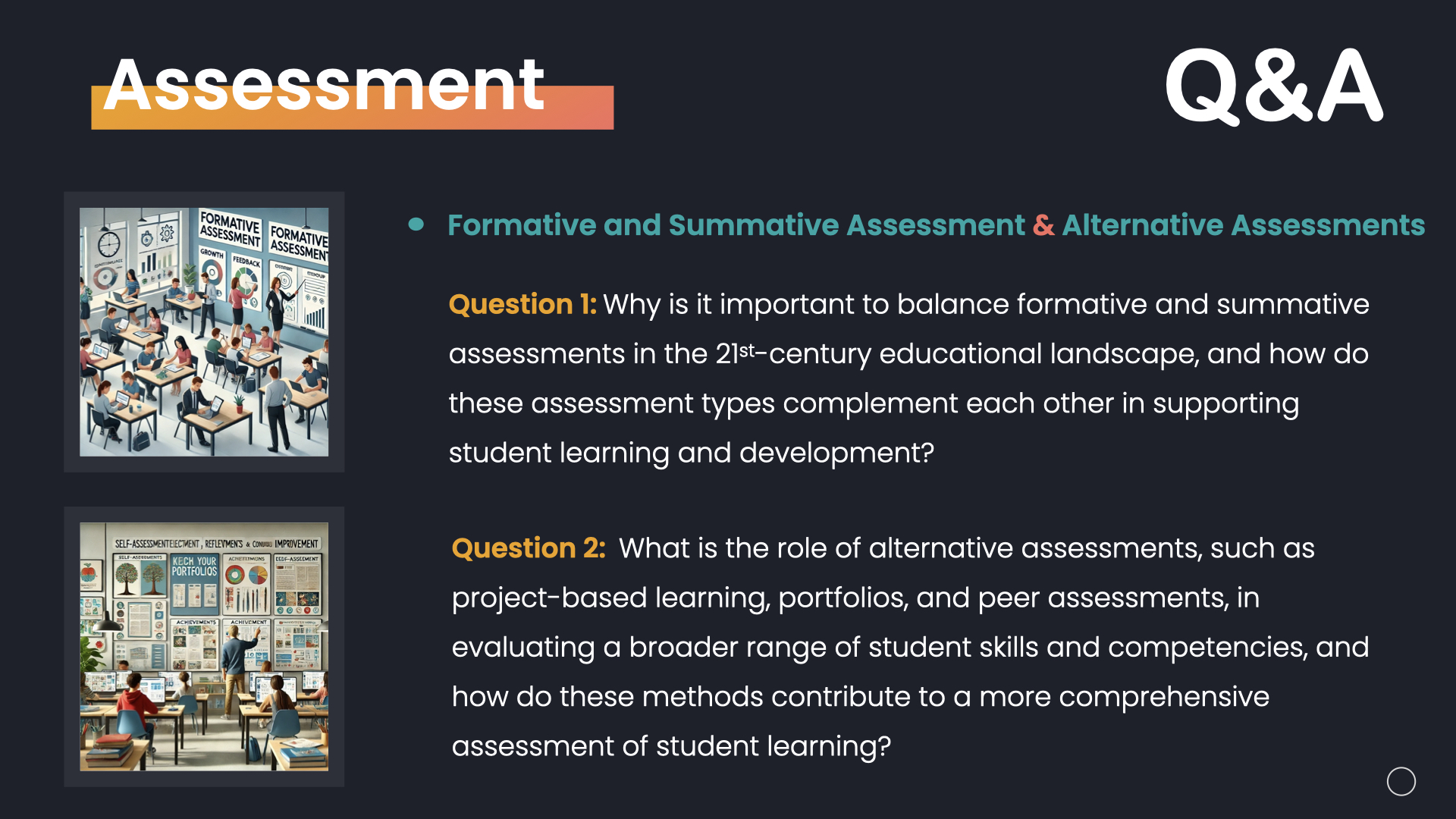
Q&A – Assessment

Q&A – Assessment

by Dr.Jim Panjarattanakorn -
Number of replies: 3


📝 Instruction

Please reflect on what you have learned from this session and answer the following two questions in at least 5–7 sentences each. You may include examples or insights from your own teaching or learning experiences.

Question 1:
Why is it important to balance formative and summative assessments in the 21st-century educational landscape, and how do these assessment types complement each other in supporting student learning and development?


Question 2:
What is the role of alternative assessments, such as project-based learning, portfolios, and peer assessments, in evaluating a broader range of student skills and competencies, and how do these methods contribute to a more comprehensive assessment of student learning?


In reply to Dr.Jim Panjarattanakorn

Re: Q&A – Assessment

by Muhammad Zuhair Ali -

Q1) Why is it important to balance formative and summative assessments in the 21st-century educational landscape, and how do these assessment types complement each other in supporting student learning and development?


Answer:

In the 21st-century learning landscape, balancing formative and summative assessments is vital to efficiently support student learning. Formative assessments are ongoing checks for understanding that occur during the learning process. These can include activities like Q&A, quizzes, peer reviews, classroom discussions, or teacher feedback. The main purpose is to provide instant insights into learners’ progress; allowing teachers to customized instruction and provide assistance students stay on track. This approach fosters a more responsive and personalized learning environment.

Whereas, Summative assessments are used to evaluate student learning at the end of a learning period, such as through final exams, projects, or standardized tests. They measure how well students have met learning objectives and provide a benchmark for overall achievement. When combined with formative assessments, they create a more balanced and effective evaluation system. Combined they not only assess outcomes but also improve the learning process by encouraging likeness, continuous improvement, long-term academic development and growth.

In reply to Dr.Jim Panjarattanakorn

Re: Q&A – Assessment

by Muhammad Zuhair Ali -

Q2) What is the role of alternative assessments, such as project-based learning, portfolios, and peer assessments, in evaluating a broader range of student skills and competencies, and how do these methods contribute to a more comprehensive assessment of student learning?

Answer:

Alternative assessments such as project-based learning, portfolios, and peer evaluations offer a more comprehensive and meaningful way to evaluate student learning beyond traditional tests. These methods focus on practical application, critical thinking, collaboration, and creativity; skills that are essential in the modern learning setting.

For example, project-based learning allows students to engage deeply with real-world scenarios, encouraging inquiry, research, and teamwork, which are difficult to assess through standard exams. Portfolios give students the opportunity to showcase their progress over time, offering a clearer picture of their growth, effort, and reflective thinking.

Peer assessments also play a vital role by fostering communication and self-awareness, as students learn to give and receive constructive feedback. From my experience, using portfolios in a L&D (learning and development) setting helped learners become more engaged and responsible for their own learning, while project-based tasks improved their ability to work collaboratively. Altogether, alternative assessments support diverse learning styles and provide educators with a comprehensive understanding of learners abilities, preparing them for both theoretical and real-life challenges.


In reply to Dr.Jim Panjarattanakorn

Re: Q&A – Assessment

by Yangin Hu -

Question 1:
Why is it important to balance formative and summative assessments in the 21st-century educational landscape, and how do these assessment types complement each other in supporting student learning and development?

Answer: Balancing formative and summative assessments is essential in 21st-century education because they serve distinct but complementary roles in promoting student learning, engagement, and overall development. As education increasingly focuses on personalized learning, critical thinking, collaboration, and life-long skills, the assessment system must evolve to support these goals.

Promotes Deep Learning
Supports Skill Development
Encourages Student-Centered Learning
Enables Personalized Feedback

Formative assessments help identify misconceptions early and guide improvement.

Summative assessments provide evidence of mastery and academic achievement.

Balancing both ensures that learning is continuous and outcome-oriented

Formative tasks foster 21st-century skills like self-reflection, collaboration, and adaptability.

Summative tasks assess content mastery, problem-solving, and synthesis of knowledge.

Formative assessment promotes student agency and metacognition (thinking about thinking).

When used well, summative tasks can serve as culminating performances that allow students to demonstrate learning in real-world contexts (e.g., presentations, capstone projects).

Formative feedback is immediate and constructive, supporting students’ individual learning journeys.

Summative results help educators evaluate curriculum effectiveness and adjust future instruction.

Question 2:

What is the role of alternative assessments, such as project-based learning, portfolios, and peer assessments, in evaluating a broader range of student skills and competencies, and how do these methods contribute to a more comprehensive assessment of student learning?

Answer: Alternative assessments are non-traditional evaluation methods that focus on performance, process, and real-world application rather than standardized test scores. Common types include:

Project-Based Learning (PBL): Students work on extended, real-world problems or challenges.

Portfolios: Collections of a student’s work over time, showcasing growth and achievement.

Peer Assessments: Students evaluate each other’s work, promoting reflection and collaborative learning.    

Contributions to a more comprehensive Assessment

✅ Authentic Learning Evidence
✅ Longitudinal View of Progress
✅ Student Agency and Engagement
✅ Supports Differentiation

Students demonstrate knowledge through application, not just memorization.

Real-world tasks reveal how well students can transfer learning beyond the classroom.

Portfolios show learning growth over time, including improvements, challenges, and achievements.

Teachers can assess development of both academic and personal competencies.

Students take ownership of their learning process.

Increases motivation by connecting assessments to real-life interests and goals.

Allows learners with diverse strengths (e.g., visual, kinesthetic) to express understanding in multiple formats.

Encourages equity and inclusion in assessment.