

Foundations of Structural Equation Modeling
1. Introduction to Structural Equation Modeling
1.3. Importance of SEM in Research
🎯 Learning Objectives
Upon completion of this subchapter, learners will be able to:
- Explain the significance of Structural Equation Modeling (SEM) in contemporary research.
- Describe the advantages of SEM for testing theoretical models.
- Explain why SEM is widely used in educational, behavioral, and social science research.
- Identify research situations where SEM is more appropriate than traditional statistical techniques.
- Recognize the contribution of SEM to theory development and validation.
1. Introduction
As research questions become increasingly complex, traditional statistical techniques such as correlation, multiple regression, and analysis of variance (ANOVA) are often insufficient to capture the multidimensional relationships among variables. Researchers frequently seek to examine not only direct effects but also indirect effects, mediating mechanisms, latent constructs, and multiple causal pathways within a single theoretical framework.
Structural Equation Modeling (SEM) addresses these analytical challenges by integrating measurement models and structural models into a unified statistical framework. This capability enables researchers to evaluate the validity of measurement instruments while simultaneously testing theoretical relationships among variables. Consequently, SEM has become one of the most influential analytical methodologies in education, psychology, management, sociology, healthcare, and many other scientific disciplines.
2. Why SEM is Important in Modern Research
SEM is considered a second-generation multivariate analysis technique because it extends beyond the capabilities of traditional statistical methods. Rather than testing isolated relationships between variables, SEM enables researchers to evaluate an entire conceptual model simultaneously.
Figure 1.3 Why Researchers Choose SEM: A Comparison of SEM with Correlation, Regression, ANOVA, and Path Analysis
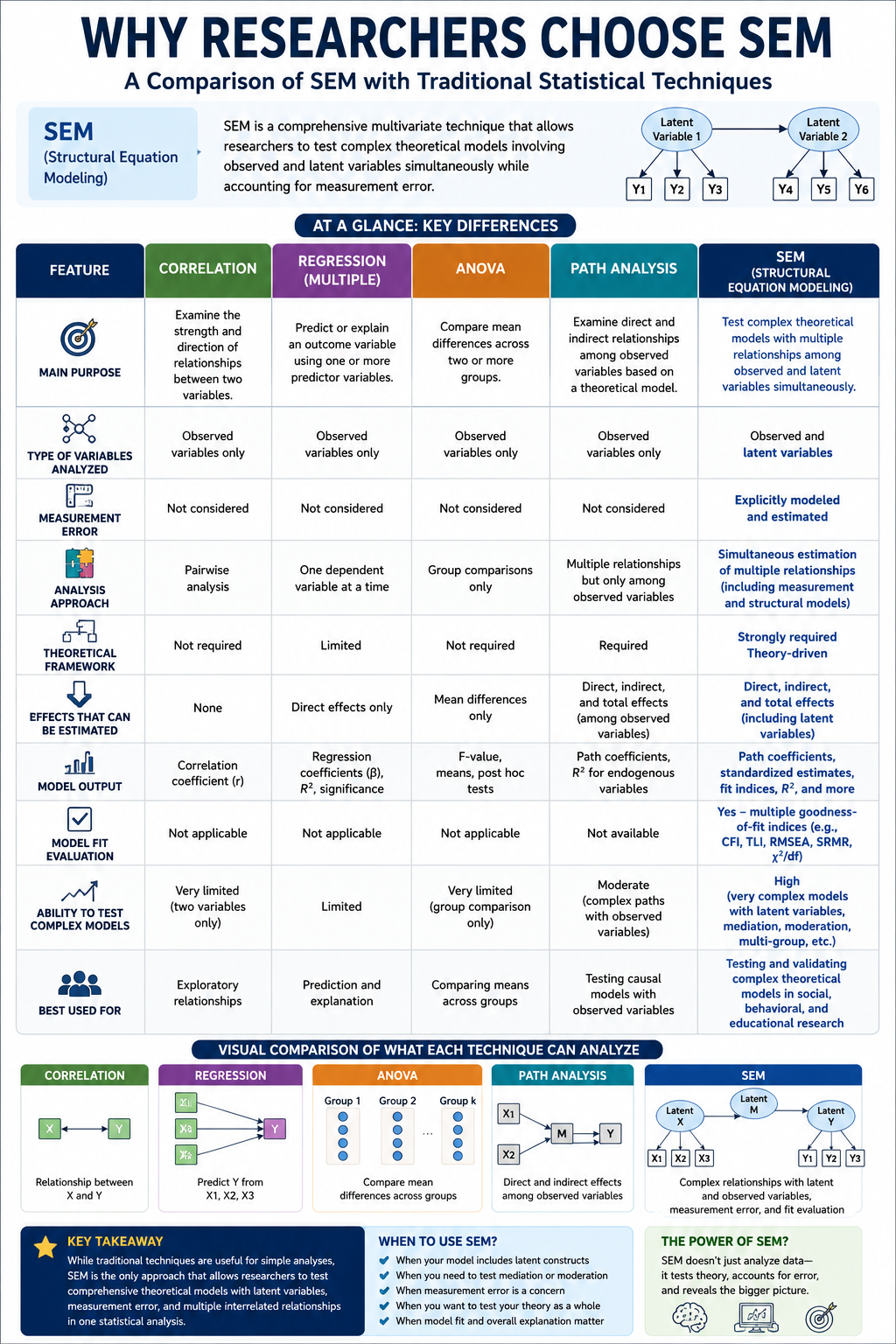
Figure 1.3 illustrates the major differences between Structural Equation Modeling (SEM) and traditional statistical techniques, including correlation analysis, multiple regression, analysis of variance (ANOVA), and path analysis. Unlike conventional methods that examine only specific aspects of relationships among observed variables, SEM simultaneously evaluates latent constructs, measurement errors, multiple causal pathways, and the overall fit between the theoretical model and empirical data. These capabilities explain why SEM has become the preferred analytical methodology for theory testing in educational and social science research.
The importance of SEM lies in its ability to provide a comprehensive understanding of complex phenomena while minimizing bias caused by measurement error.
Major reasons include:
- Testing comprehensive theoretical models
- Simultaneous estimation of multiple relationships
- Explicit modeling of latent variables
- Control of measurement error
- Assessment of model fit
- Support for theory development and validation
3. Importance of SEM in Theory Testing
One of the primary purposes of scientific research is to test theoretical propositions. SEM is particularly valuable because it allows researchers to examine whether empirical data support a proposed conceptual framework.
Unlike traditional regression analysis, which evaluates individual equations separately, SEM estimates all structural relationships simultaneously while considering the interdependence among variables.
This capability strengthens theory testing by allowing researchers to evaluate:
- Direct effects
- Indirect effects
- Total effects
- Mediating relationships
- Moderating relationships
- Complex causal structures
As a result, SEM has become the preferred methodology for confirmatory research.
4. Importance of SEM in Educational Research
Educational research frequently investigates constructs that cannot be measured directly. Examples include:
- Learning motivation
- Student engagement
- Creativity
- Digital literacy
- Teacher effectiveness
- Leadership
- Organizational commitment
- Academic resilience
These constructs are latent variables that require multiple observed indicators for accurate measurement.
SEM enables researchers to:
- Validate measurement instruments using Confirmatory Factor Analysis (CFA)
- Test theoretical relationships among educational constructs
- Examine causal pathways affecting learning outcomes
- Evaluate educational intervention models
- Improve the accuracy of educational decision-making
Consequently, SEM has become one of the most widely used statistical methods in educational administration, curriculum studies, educational technology, and educational psychology.
5. Importance of SEM in Social and Behavioral Sciences
SEM has significantly advanced research in psychology, sociology, business, healthcare, and organizational studies by enabling the investigation of complex human behaviors.
Researchers use SEM to study:
- Customer satisfaction
- Consumer behavior
- Employee engagement
- Organizational commitment
- Leadership effectiveness
- Emotional intelligence
- Mental health
- Quality of life
The flexibility of SEM allows researchers to construct comprehensive models that better reflect real-world phenomena.
6. Comparison with Traditional Statistical Methods
| Traditional Statistical Methods | Structural Equation Modeling |
|---|---|
| Examine individual relationships | Examine an entire theoretical model |
| Limited to observed variables | Include observed and latent variables |
| Ignore measurement error | Explicitly estimate measurement error |
| Separate analyses required | Simultaneous estimation of multiple relationships |
| Limited mediation analysis | Comprehensive mediation and moderation analysis |
| No assessment of overall model fit | Evaluate model fit using multiple fit indices |
7. Contribution of SEM to Scientific Research
SEM has transformed modern scientific research by providing researchers with tools to:
- Develop stronger theoretical models.
- Validate research instruments.
- Test causal relationships more accurately.
- Evaluate complex systems involving multiple variables.
- Improve the reliability and validity of research findings.
- Generate stronger empirical evidence for theory building.
For these reasons, SEM is regarded as one of the most powerful analytical approaches available for hypothesis testing and theory confirmation.
8. Practical Applications of SEM
SEM has been applied extensively in numerous disciplines.
Education
- Educational leadership
- Technology acceptance
- Learning achievement
- Student engagement
- Creativity
- Digital competence
Business
- Organizational performance
- Customer loyalty
- Brand equity
- Employee satisfaction
Health Sciences
- Health behavior
- Patient satisfaction
- Healthcare quality
- Mental health interventions
Social Sciences
- Social capital
- Public policy evaluation
- Community development
- Social behavior
9. Key Takeaways
After completing this subchapter, learners should understand that:
- SEM is one of the most important analytical methods for contemporary research.
- SEM enables researchers to test complex theoretical models.
- SEM simultaneously evaluates measurement quality and structural relationships.
- SEM provides stronger evidence for theory validation than many traditional statistical techniques.
- SEM has become the preferred analytical approach in education, psychology, management, healthcare, and social sciences.
10. Reflection Questions
- Why is SEM considered a second-generation multivariate statistical technique?
- What advantages does SEM provide over multiple regression analysis?
- Why is SEM particularly valuable in educational research?
- How does SEM contribute to theory development and validation?
- In your own research area, how could SEM improve the quality of empirical investigation?
📝 Suggested Readings (APA 7th)
- Byrne, B. M. (2022). Structural Equation Modeling with AMOS: Basic Concepts, Applications, and Programming (4th ed.). Routledge.
- Hair, J. F., Black, W. C., Babin, B. J., & Anderson, R. E. (2022). Multivariate Data Analysis (9th ed.). Cengage.
- Kline, R. B. (2023). Principles and Practice of Structural Equation Modeling (5th ed.). Guilford Press.
- Schumacker, R. E., & Lomax, R. G. (2022). A Beginner's Guide to Structural Equation Modeling (5th ed.). Routledge.