

Foundations of Structural Equation Modeling
1. Introduction to Structural Equation Modeling
1.5. Limitations of SEM
🎯 Learning Objectives
Upon completion of this subchapter, learners will be able to:
- Explain the major limitations of Structural Equation Modeling (SEM).
- Identify common challenges encountered when applying SEM in research.
- Recognize the assumptions underlying SEM analysis.
- Evaluate situations in which SEM may not be the most appropriate statistical technique.
- Apply strategies to minimize the limitations of SEM in research practice.
1. Introduction
Although Structural Equation Modeling (SEM) is recognized as one of the most powerful multivariate statistical techniques, it is not without limitations. Like all statistical methodologies, SEM relies on a number of theoretical assumptions, methodological requirements, and practical considerations that researchers must carefully address before conducting an analysis.
Many problems encountered in SEM are not caused by the software itself but by inadequate research design, insufficient sample size, poor measurement quality, or inappropriate model specification. Consequently, researchers should understand both the strengths and limitations of SEM to ensure that the technique is applied appropriately and that research findings are interpreted accurately.
2. Major Limitations of SEM
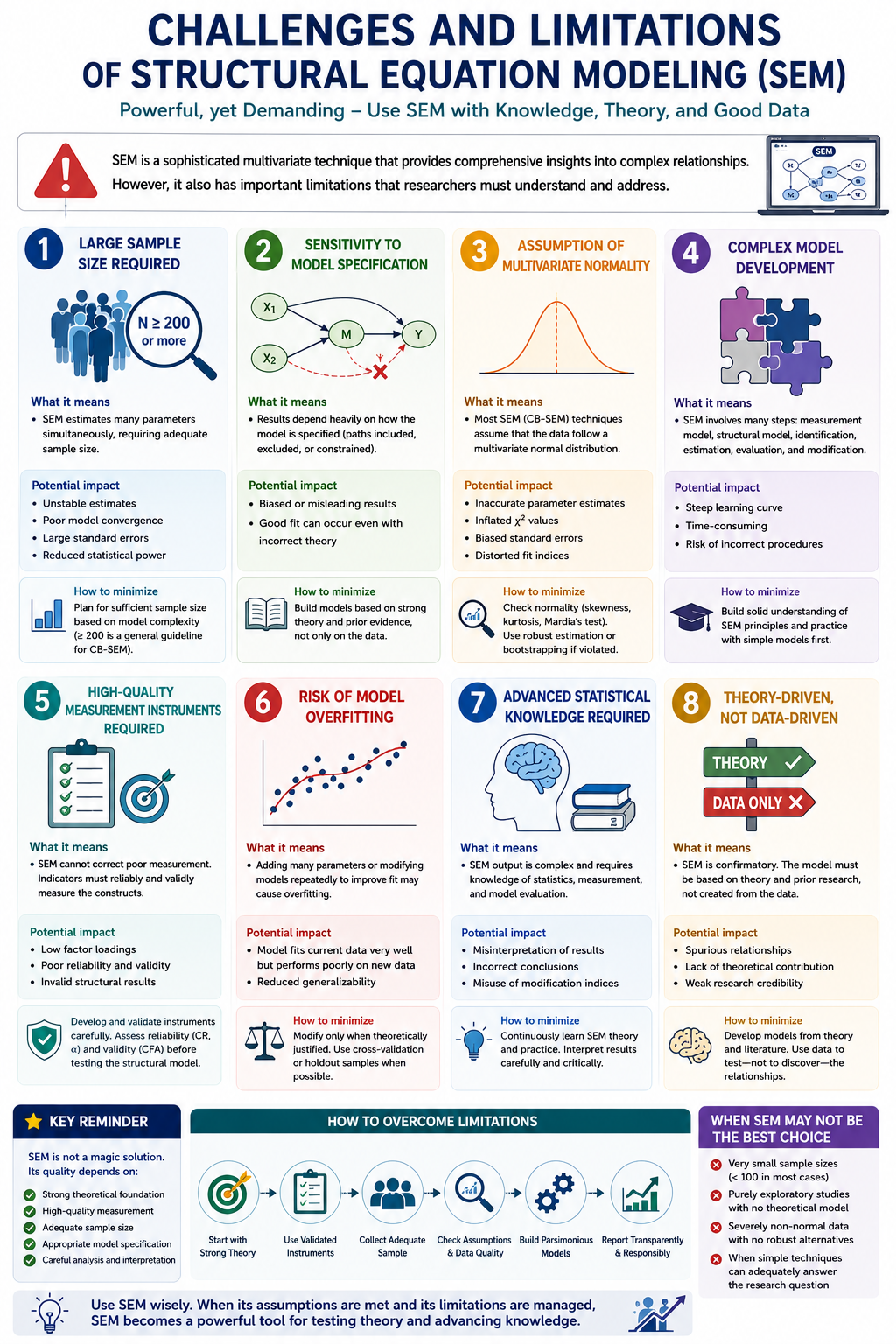
Despite its analytical power, SEM has several important limitations, including:
- Large sample size requirements
- Sensitivity to model specification
- Assumptions of multivariate normality
- Complexity of model development
- Dependence on theoretical justification
- Sensitivity to poor-quality measurement instruments
- Risk of model overfitting
- Requirement for advanced statistical knowledge
Understanding these limitations helps researchers make informed methodological decisions.
Figure 1.5 Challenges and Limitations of Structural Equation Modeling (SEM)
3. Large Sample Size Requirements
One of the most frequently discussed limitations of SEM is the need for relatively large sample sizes.
Because SEM estimates many parameters simultaneously, insufficient sample sizes may lead to:
- Unstable parameter estimates
- Poor model convergence
- Inflated standard errors
- Reduced statistical power
Although recommended sample sizes vary depending on model complexity, many researchers suggest a minimum of 200 observations for covariance-based SEM, while more complex models may require substantially larger samples.
4. Sensitivity to Model Specification
SEM is highly dependent on the correctness of the proposed theoretical model.
If researchers specify incorrect causal relationships, omit important variables, or include inappropriate paths, the resulting estimates may be misleading even when model-fit indices appear acceptable.
Therefore, SEM should always be theory-driven rather than data-driven.
5. Assumptions of Multivariate Normality
Most covariance-based SEM techniques assume that the observed data follow a multivariate normal distribution.
Violations of this assumption may affect:
- Parameter estimation
- Standard errors
- Chi-square statistics
- Model-fit indices
Researchers should therefore conduct preliminary data screening before SEM analysis.
6. Complexity of Model Development
Compared with traditional statistical methods, SEM requires considerably more expertise.
Researchers must understand:
- Measurement theory
- Confirmatory Factor Analysis (CFA)
- Structural models
- Model identification
- Parameter estimation
- Model evaluation
- Model modification
This complexity increases the learning curve for beginning researchers.
7. Dependence on High-Quality Measurement Instruments
SEM cannot compensate for poorly designed questionnaires or unreliable measurement instruments.
If observed indicators fail to measure latent constructs accurately, the resulting structural model will also be unreliable.
For this reason, instrument development and validation are essential prerequisites for successful SEM analysis.
8. Risk of Model Overfitting
Researchers sometimes modify their models repeatedly to improve model-fit indices.
Excessive modification based solely on statistical criteria may result in overfitting, where the model fits one dataset exceptionally well but performs poorly when applied to other samples.
Model modification should therefore be guided by both statistical evidence and theoretical justification.
9. Interpretation Requires Advanced Knowledge
SEM output contains numerous statistical indices, including:
- Factor loadings
- Regression weights
- Covariances
- Standardized estimates
- Modification indices
- Goodness-of-fit statistics
Correct interpretation requires a solid understanding of statistical theory and SEM methodology.
Without adequate knowledge, researchers may draw incorrect conclusions despite obtaining statistically significant results.
10. Summary of Limitations
| Limitation | Potential Impact |
|---|---|
| Large sample requirement | Reduced statistical power with small samples |
| Model misspecification | Biased or misleading conclusions |
| Non-normal data | Inaccurate parameter estimates |
| Complex procedures | Steep learning curve |
| Poor measurement instruments | Invalid latent constructs |
| Model overfitting | Limited generalizability |
| Advanced statistical knowledge required | Risk of incorrect interpretation |
11. Strategies for Minimizing Limitations
Researchers can reduce the impact of these limitations by:
- Developing a strong theoretical framework.
- Using validated measurement instruments.
- Collecting adequate sample sizes.
- Conducting comprehensive data screening.
- Evaluating assumptions before analysis.
- Avoiding unnecessary model modification.
- Interpreting results within both theoretical and statistical contexts.
These practices enhance the credibility and robustness of SEM-based research.
12. Key Takeaways
After completing this subchapter, learners should understand that:
- SEM is a powerful methodology but requires careful application.
- Successful SEM analysis depends on strong theoretical foundations and high-quality data.
- Large sample sizes and reliable measurement instruments are critical.
- Researchers should avoid relying solely on model-fit indices when evaluating models.
- Understanding the limitations of SEM leads to more rigorous and trustworthy research.
13. Reflection Questions
- Why is sample size particularly important in SEM?
- How can incorrect model specification affect SEM results?
- Why should model modification always be supported by theory?
- What strategies can researchers use to reduce the limitations of SEM?
- In your own research, which limitation of SEM is likely to present the greatest challenge?
📝 Suggested Readings (APA 7th)
- Byrne, B. M. (2022). Structural Equation Modeling with AMOS: Basic Concepts, Applications, and Programming (4th ed.). Routledge.
- Hair, J. F., Black, W. C., Babin, B. J., & Anderson, R. E. (2022). Multivariate Data Analysis (9th ed.). Cengage.
- Kline, R. B. (2023). Principles and Practice of Structural Equation Modeling (5th ed.). Guilford Press.
- Schumacker, R. E., & Lomax, R. G. (2022). A Beginner's Guide to Structural Equation Modeling (5th ed.). Routledge.