

Foundations of Structural Equation Modeling
1. Introduction to Structural Equation Modeling
1.6. Applications of SEM in Educational Research
🎯 Learning Objectives
Upon completion of this subchapter, learners will be able to:
- Explain the major applications of Structural Equation Modeling (SEM) in educational research.
- Identify educational research topics that are appropriate for SEM analysis.
- Distinguish between research problems suitable for SEM and those better addressed by traditional statistical methods.
- Describe how SEM contributes to theory development and evidence-based educational decision-making.
- Develop preliminary ideas for applying SEM in their own research.
1. Introduction
Educational research has become increasingly complex due to the multidimensional nature of teaching, learning, leadership, organizational behavior, and educational policy. Many educational constructs—such as learning motivation, instructional quality, digital literacy, teacher effectiveness, and organizational commitment—cannot be measured directly. Instead, these constructs are represented by multiple observable indicators and often interact through complex causal relationships.
Structural Equation Modeling (SEM) provides researchers with a comprehensive analytical framework capable of simultaneously validating measurement instruments and testing theoretical relationships among latent constructs. Consequently, SEM has become one of the most widely adopted statistical methodologies in educational research, particularly at the master's and doctoral levels.
2. Why Educational Researchers Use SEM
Figure 1.6. Major applications of Structural Equation Modeling (SEM) across six key areas of educational research, including Educational Leadership, Teaching and Learning, Educational Technology, Curriculum and Instruction, Teacher Education, and Higher Education. Each application illustrates how SEM supports theory testing, latent variable analysis, and evidence-based educational research.
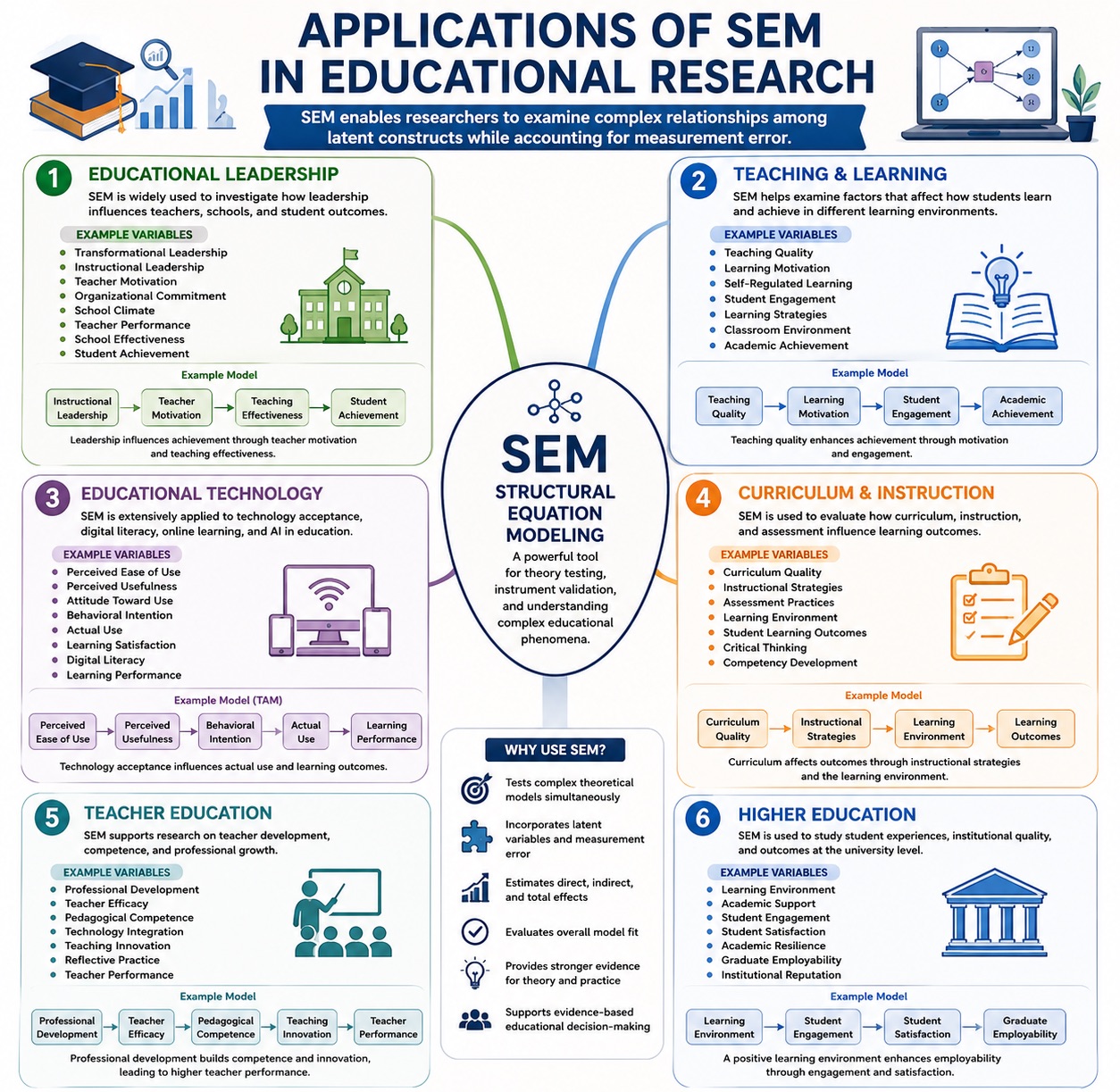
Figure 1.6 presents the major domains in which Structural Equation Modeling (SEM) is widely applied in educational research. Although each area focuses on different educational issues, they share common characteristics, including the investigation of latent constructs, complex causal relationships, and theory-driven research models. SEM enables researchers to validate measurement instruments and examine multiple relationships simultaneously, making it particularly suitable for contemporary educational studies.
Rresearchers increasingly adopt SEM because it allows them to examine multiple educational variables within a single theoretical framework while accounting for measurement error.
SEM is particularly useful when research involves:
- Latent constructs measured by multiple indicators.
- Complex causal relationships.
- Mediating or moderating variables.
- Theory testing and validation.
- Instrument validation through Confirmatory Factor Analysis (CFA).
These characteristics make SEM highly suitable for addressing contemporary educational research questions.
3. Major Areas of Application in Educational Research
SEM has been widely applied across various domains of educational research.
3.1 Educational Leadership
SEM is frequently used to investigate relationships among:
- Transformational leadership
- Instructional leadership
- Organizational commitment
- Teacher performance
- School effectiveness
Example Research Model
Instructional Leadership
           ↓
Teacher Motivation
           ↓
Teaching Effectiveness
           ↓
Student Achievement
3.2 Teaching and Learning
Researchers apply SEM to examine factors influencing learning outcomes.
Common variables include:
- Learning motivation
- Self-regulated learning
- Classroom engagement
- Teaching quality
- Academic achievement
Example
Teaching Quality
        ↓
Learning Motivation
        ↓
Student Engagement
        ↓
Academic Achievement
3.3 Educational Technology
SEM has become one of the most frequently used analytical methods in educational technology research.
Applications include:
- Technology Acceptance Model (TAM)
- Digital Literacy
- Artificial Intelligence in Education
- Online Learning
- Blended Learning
- Learning Management Systems (LMS)
Typical variables include:
- Perceived Ease of Use
- Perceived Usefulness
- Behavioral Intention
- Learning Satisfaction
- Learning Performance
3.4 Curriculum and Instruction
Researchers use SEM to investigate:
- Curriculum quality
- Teaching strategies
- Assessment practices
- Learning outcomes
- Competency development
SEM enables researchers to determine how curriculum implementation influences student achievement through mediating instructional variables.
3.5 Teacher Education
SEM is widely used in teacher education research.
Typical constructs include:
- Teacher efficacy
- Professional development
- Pedagogical competence
- Technology integration
- Teaching innovation
These constructs are often modeled as latent variables measured by multiple questionnaire items.
3.6 Higher Education
Applications include studies of:
- Student satisfaction
- Graduate employability
- Academic resilience
- Research competency
- Learning engagement
- University governance
- Quality assurance
4. Typical Educational Research Frameworks Using SEM
Several theoretical frameworks commonly employ SEM.
Examples include:
Technology Acceptance Model (TAM)
Perceived Ease of Use
↓
Perceived Usefulness
↓
Behavioral Intention
↓
Actual Use
Unified Theory of Acceptance and Use of Technology (UTAUT)
Performance Expectancy
↓
Behavioral Intention
↓
Technology Use
Student Engagement Model
Teaching Quality
↓
Learning Motivation
↓
Student Engagement
↓
Academic Achievement
Educational Leadership Model
Leadership
↓
Teacher Motivation
↓
Instructional Quality
↓
Student Performance
5. Benefits of Using SEM in Educational Research
SEM offers numerous advantages for educational researchers.
It enables researchers to:
- Validate educational measurement instruments.
- Examine relationships among multiple educational variables.
- Estimate direct, indirect, and total effects.
- Test complex conceptual frameworks.
- Reduce bias caused by measurement error.
- Improve theoretical explanations of educational phenomena.
- Provide stronger empirical evidence for educational policy and practice.
6. Example Research Topics Suitable for SEM
| Research Area | Example Topic |
|---|---|
| Educational Leadership | Leadership → Teacher Motivation → School Effectiveness |
| Educational Technology | Digital Literacy → Learning Engagement → Academic Achievement |
| Higher Education | Learning Environment → Student Satisfaction → Graduate Employability |
| Teacher Education | Professional Development → Teaching Competence → Teaching Innovation |
| Educational Psychology | Self-Efficacy → Learning Motivation → Academic Performance |
| Curriculum Studies | Curriculum Quality → Teaching Practice → Learning Outcomes |
7. When Should Educational Researchers Use SEM?
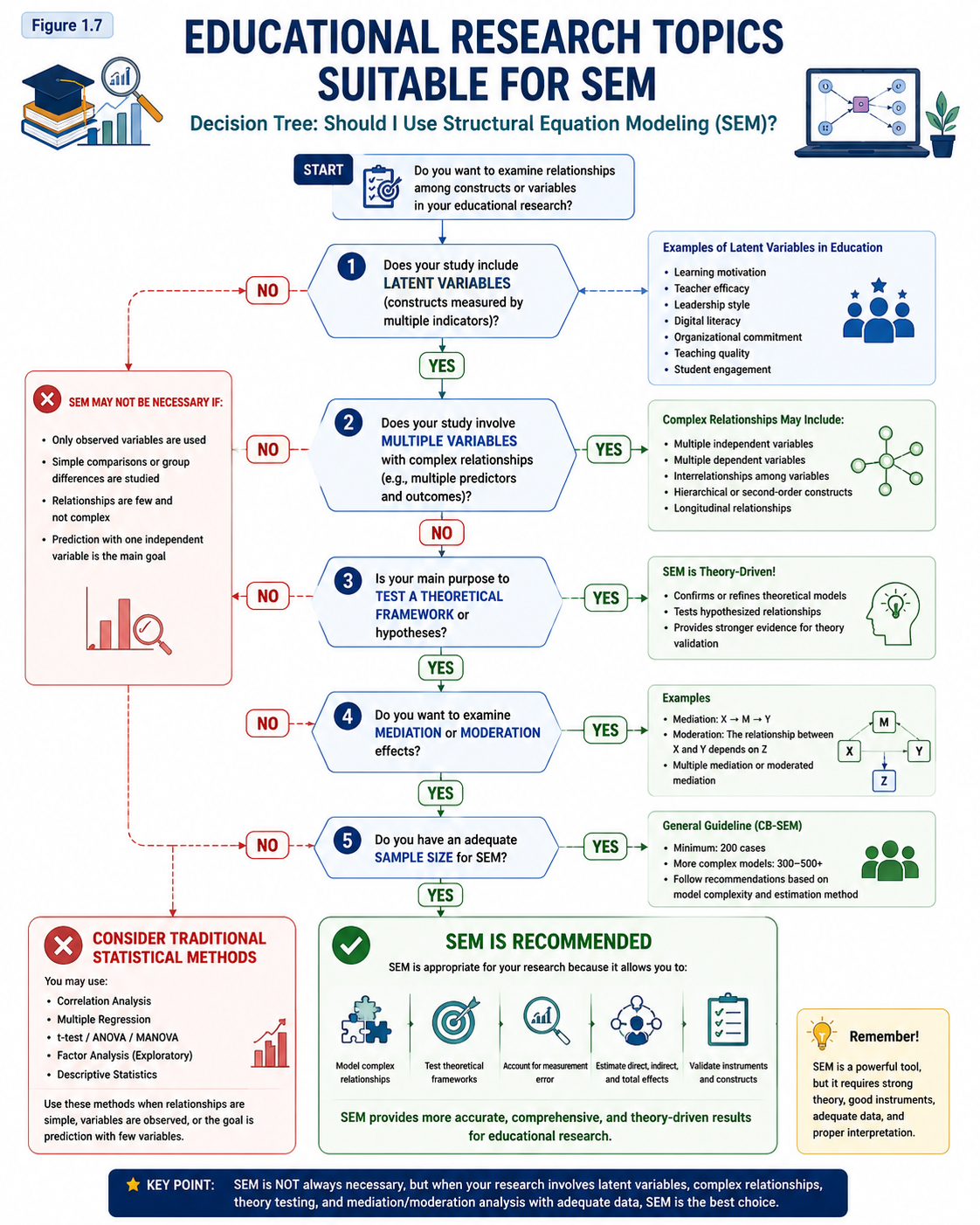
SEM is recommended when:
✅ The conceptual framework contains latent variables.
✅ Multiple causal relationships are examined simultaneously.
✅ Theory testing is the primary research objective.
✅ Mediation or moderation effects are investigated.
✅ Instrument validation is required.
SEM may not be appropriate when:
- The study contains only one independent variable and one dependent variable.
- Sample size is insufficient.
- The research is purely exploratory with no theoretical framework.
8. Key Takeaways
After completing this subchapter, learners should understand that:
- SEM has become one of the most important analytical methods in educational research.
- Educational constructs are frequently latent variables that require SEM for accurate measurement.
- SEM supports theory testing, instrument validation, and complex causal modeling.
- Educational leadership, educational technology, teacher education, curriculum studies, and educational psychology are among the fields that benefit most from SEM.
- Appropriate application of SEM contributes to more reliable educational research and evidence-based decision-making.
9. Reflection Questions
- Why are latent variables common in educational research?
- Which educational research topics are particularly suitable for SEM?
- How does SEM improve educational theory testing?
- Which conceptual framework in your own research could benefit from SEM?
- Under what circumstances would traditional statistical techniques be preferable to SEM?
📝 Suggested Readings (APA 7th)
- Byrne, B. M. (2022). Structural Equation Modeling with AMOS: Basic Concepts, Applications, and Programming (4th ed.). Routledge.
- Hair, J. F., Black, W. C., Babin, B. J., & Anderson, R. E. (2022). Multivariate Data Analysis (9th ed.). Cengage.
- Kline, R. B. (2023). Principles and Practice of Structural Equation Modeling (5th ed.). Guilford Press.
- Schumacker, R. E., & Lomax, R. G. (2022). A Beginner's Guide to Structural Equation Modeling (5th ed.). Routledge.